
Interview: Elite referee Eva Svärdsudd – 2023-08-24
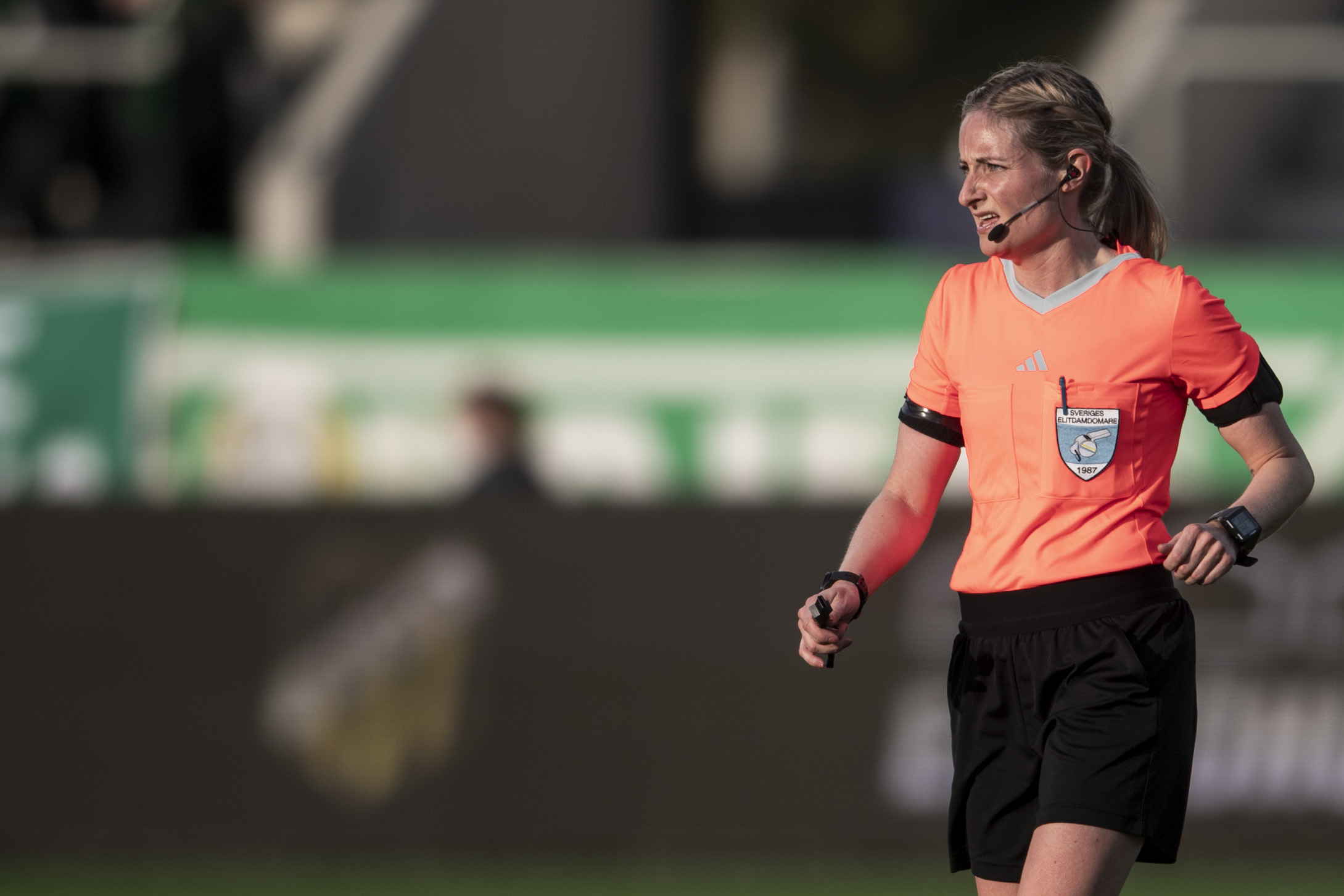
Interview with elite referee Eva Svärdsudd
In 2022, Eva Svärdsudd was named the Referee of the Year in Sweden, the same year she made her debut in the OBOS Damallsvenskan, highest women's league in Sweden. Behind this recognition lies hard work, humility, and a lot of match analysis. We delved a bit deeper into conversation with Eva, who shared her journey as a referee and other thoughts about the role of officiating. We are also particularly proud of Eva, who referees with a Spintso watch. Read the full interview below.
– Hello Eva. Could you briefly tell us who you are?
– I'm 39 years old and will be celebrating a milestone birthday this autumn. I have two children, aged 10 and 15. I live in northern Sweden, in Piteå, and work as a teacher at a resource school. I'm really fond of sports, primarily football but also handball. I've also been a player in both these sports.
– You're also a football referee. Can you rewind the tape and tell us how it all began?
– When I was quite young, like a teenager, I refereed youth football and it continued on that path. I often heard that the teams and those around me were satisfied with my performance as a referee. At that time, I was refereeing in my home club while also playing football myself. Later on, I became pregnant with my eldest daughter and stopped playing football. After that, my children's grandfather said, "...aren't you going to take a referee course now?" I didn't think much about it and just said, "Yes, why not." That's how it started. I began refereeing when I was around 25 years old, officiating senior football and as a district referee at that time. After that, I also lived in Luleå and continued my studies to become a teacher, which is also my profession today.
– You mentioned that those around and the teams were satisfied with you as a referee. Why do you think that was?
– Oh, that's a good question. I was probably the type of player who might have complained a little, maybe a bit too much, about the referee if I'm being honest. I think when you referee younger players, they like it when you're engaged, and that goes for coaches and the audience too. It's important to show that you're present, that you want to be there, and that you're enjoying yourself. You want to convey that to the younger players. I think that's why... I enjoyed it, and that enthusiasm might have spread to those around as well. It's important to show engagement as a referee, and there are many different ways to do that.
– They were the younger players. Now you referee football and older players, senior football. Why do you think you referee and have made it a significant part of your life?
– Because I find it incredibly enjoyable! I love football, and I love being a part of that football family. It provides me with a lot as an individual to be a referee. I personally feel that I've grown a lot as a person since I started refereeing football. It's hard for me to imagine not refereeing football; it's like it's a part of my life. It's a jigsaw puzzle of life, and you have to plan quite a bit – training, matches, and travel. It's a part of my daily routine and my life, so to speak. My children usually ask, "When do you have a match this week, Mom?" Haha. But now they're getting old enough that they can manage on their own a bit if I have a match.
– Developed as a person, you say. Interesting. How do you feel you've developed as a person through being a referee?
– I work as a teacher, so I consider myself fairly pedagogical. Being a referee and a teacher go hand in hand to some extent. In the past and quite a while back, I might have been cautious and a bit shy, and it's a bit challenging when you're a referee. You need to assert yourself, in the right way, as a referee. In that aspect, I believe I've developed, and even people around me say the same thing. As a referee, you need to be a leader, a role model, be visible yet not overly so... since I'm the one with the whistle, in the center, leading my team, you also step into a leadership role in a way. If you've had a tough day, you're tired or feeling foggy in the head, something changes the moment you put on your referee uniform. In the changing room, I always feel, "YES, this is what I'm passionate about." That feeling grows as you approach each match, from the days before, the journey there, and when you step onto the field. Something happens within you. It's worth all the time and effort. I think it's somewhat similar to how players feel as well.
– I've had some challenging periods in my life, and refereeing has been my salvation during those times. It becomes a sanctuary. When you train and referee football, you can let go of everything else for a while and just enter that zone. Then, everyone in my family has supported me and made it possible; ultimately, family comes first. But I think having your own sanctuary is important, doing something you enjoy.
– Okay. If we delve more into the role of being a referee. What is it that makes you love the sport and being a referee so much?
– The sanctuary, as I mentioned, is important to me. Then, the colleagues around me are crucial and wonderful as heck. Especially now that I'm in the highest league of women in Sweden, where I get to meet the same colleagues and know which assistant referees I'll have with me. We've become a very close-knit group, and it feels like everyone cares for each other and wants each other to succeed. Usually, I referee men's matches one week and women's matches the next. There's a charm in refereeing at home, I usually officiate Division 2 men's matches. Then, you go to a smaller venue somewhere, enjoy a coffee break, meet new people, and by then, everyone knows who the "Eva the Referee" is, which is also fun.
– Isn't that combination really wonderful? Refereeing both men's and women's matches, longer and shorter trips?
– It's wonderful! It suits me really well. Especially for fitting the puzzle of life, but I also develop both as a referee and as a person by officiating both.
– Let's switch topics for a moment. There's a shortage of referees alsmost everywhere in the world and at all levels. What are your thoughts on that?
– A big and tough question. Being a referee is a vulnerable profession or hobby. I believe that referees sometimes have to endure quite a bit of hardship. I started refereeing when I was in my early twenties, and if you're younger than 15 or so, it's quite tough to step onto the field alone. I always have a team of three supporting me, and we help each other, but when you start refereeing, you're often alone. This is actually most important when you're new and on your own - to be together, have support, and a safety net. There's a lot of talk about mentorship for new referees, and it's crucial. But I also understand that it's difficult in practice to arrange. It requires more people and more time. If there isn't time, it won't achieve anything. It's important that we all work together and try to look out for new referees and assist them. If they have a match and something goes wrong, it's easy for them to lose motivation and quit. This is where we need better support, in some way. It's not always the players or coaches; sometimes it's the spectators who behave badly. It's not easy to stand up to adults when you're 15 years old. However, it's a big and challenging issue - but an important one. We must do more, and we can do more.
– Last year, in 2022, you were selected as the Referee of the Year in Sweden. How have you worked to achieve that?
– It was my first year in the highest women's league, but of course, there are quite a few years behind that. I arrived relatively late in elite football, for various reasons, but I've put in an incredible amount of work behind the scenes. It's not just about one year, as one might think. Partly, I had the opportunity to officiate many good matches where things went well. But I believe the main reason is that I've raised my lowest level, and I'm quite consistent in my matches. I hope and believe that people know what they'll get when they assign me to a match. That's why I also received some important matches last year, as my coach probably thought I could handle them. Another factor is my age; I'm a bit older and have gained valuable experience. I don't get nervous anymore, that feeling is completely gone. Of course, I get an adrenaline rush at places like Tele2 Arena or in a derby with record attendance, and I'm more alert, but I'm more excited and motivated than nervous. I still consider myself humble and eager to learn more. Even at 39 years old, I don't feel satisfied; I want to keep progressing continually. At this level, it's about small steps. It's about wanting to adjust tiny details, maybe not visible outwardly, but that make a match easier for me. When I took the fourth step to officiate in the Damallsvenskan, I had an "aha" moment. Is this how you should think when refereeing football? It was a great course! It was a bit of an eye-opener.
– Tell me more, why did it make you think differently?
– Part of it was the instructor we had, who covered the most significant change for me as a referee: How I should move within the penalty area. As a referee, you always try to anticipate where the next situation will occur or where the next problem area might arise. Often, that's within the penalty area, and that's where these small but crucial movements are needed. I shouldn't be "in" the penalty area, but rather move sideways or backward to get the best view. To give myself the best conditions to see well. We worked a lot on that during the course and put a lot of focus on it. Movement and positioning are always things referees need to work on across the whole field. However, here, there was more focus for me around and inside the penalty area. A significant difference from when I officiated at lower levels was that back then, I had an observer occasionally. Now, I have one for every match. There was very little audience, you did what you were supposed to, and you left the field somewhat content without knowing better. To develop, you need someone watching you and assisting you. You receive tips and learn new things you haven't heard before.
– Which areas have you developed the most as a referee since you began?
– I would say game understanding has always been my strong suit. It's always been good, but it can always get better, of course. I've always backed up my decisions with my understanding of the game because I've generally been in the right place. On the other hand, speed and explosiveness have been ongoing areas of development for me. These are things I've consistently recognized as needing improvement and more work. They're areas where I've invested a lot of time and energy, and I've gradually gotten better. It's something that even comes with age... haha. Now when I approach the fitness test, I'm confident and I know I'll pass it. That wasn't the case before. It's been intense work for over three years, training 5-6 days a week following a program from my fitness coach. I've been tough and meticulous, and my body has kept up, without injuries.
– What are you looking forward to in the fall of 2023?
– During the mid-season referee meeting, we review how the season has gone so far, watch clips, and collaborate in assessing situations. It's important that our evaluations are as consistent as possible. The spring season has been tough because more matches were squeezed in due to a World Cup. The summer break was much-needed for me, especially considering the travel. I live in northern Sweden, and every match involves traveling. But right after this meeting and course, you become really excited about matches. Then you also watch the World Cup and get even more fired up. And then you watch Tess Olofsson, refereeing in the World Cup, and you feel proud. It will be fun when things start up for real again. The Damallsvenskan is a competitive league, so you need to be on your toes. Every match matters, and it feels like any team can beat any other. I look forward to having some great matches and finishing the season as well as possible. There's still a long way to go, as we have matches into November.
– Thank you for this, Eva. Good luck with the season!
– Thank you as well! And, if anyone is reading this and considering becoming a referee, take the chance! It has changed my whole life for the better. I've grown as a person. You get to meet lots of new people and see different places. Seize the opportunity, because being a referee is incredibly fun and rewarding!