
Interview: Almira Spahic FIFA assistant referee and elitereferee in Sweden 2022-02-02
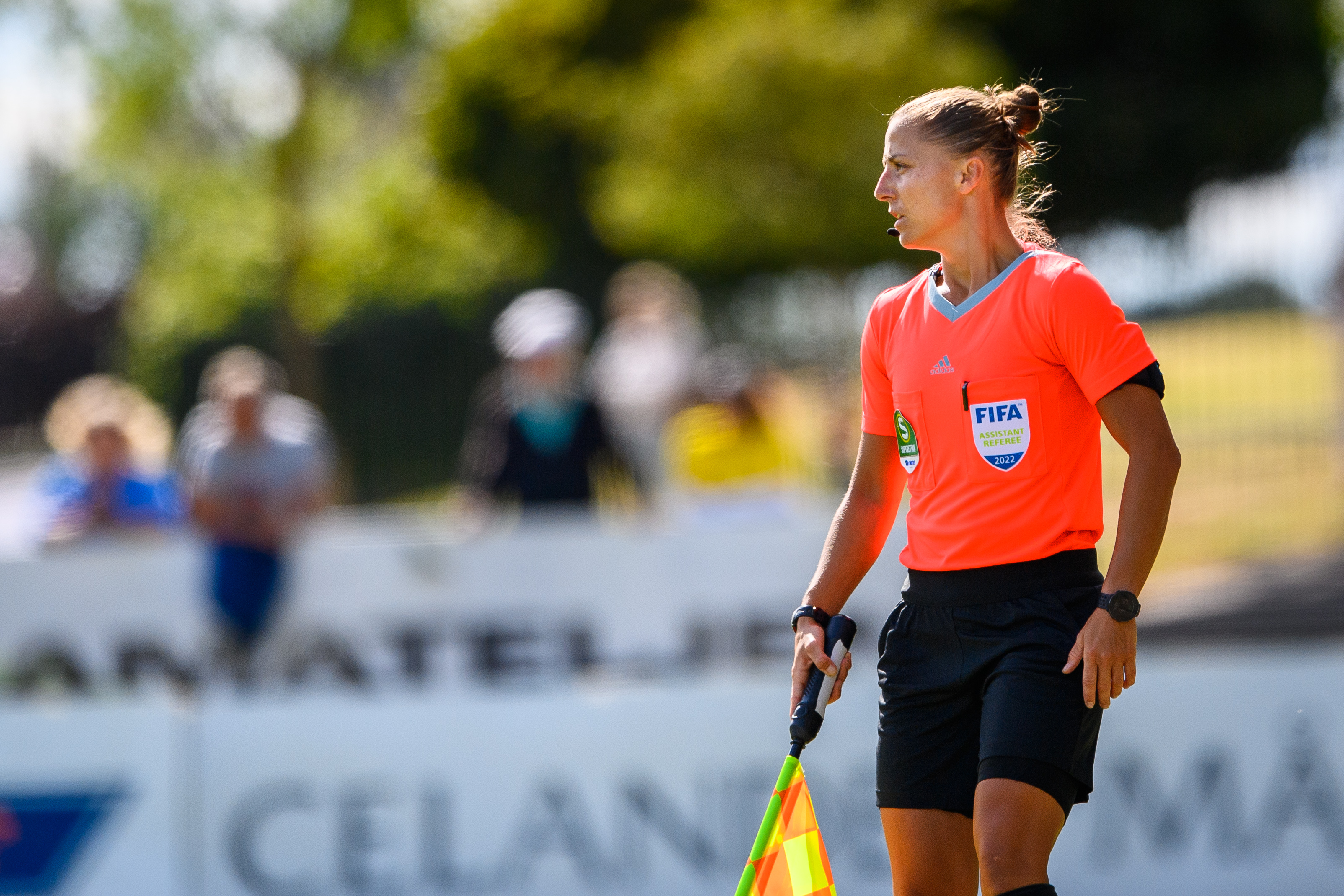
Interview with FIFA assistant referee Almira Spahic
Almira Spahic won the Referee of the Year in Sweden in 2021 and became historic, along with Tess Olofsson and Ida Källström, as they became the first female referee team to referee the Superettan (next highest league for men) in Sweden in 2022. Almira has been a professional player and has represented Bosnia on the national team level. Her best football memory as a player was a quarter-final in the Champions League where she also scored a goal, and as a referee, she immediately thinks of when she refereed a semi-final in the Champions League. Read the full interview with Almira below.
– Hello Almira. Can you tell us a bit about yourself?
– I live just outside of Gothenburg and have only lived in Sweden for 3 years and 4 months. I come from Bosnia and Sarajevo and have been refereeing football since 2004. I have been a professional football player and have represented Bosnia, but I decided to start refereeing instead because of some injuries and I started working in the military. It was too much and couldn't be managed. But starting to referee was then a way to stay on the field and still have a nice feeling when you are out there. Today I work as a teacher, more specifically a physical education teacher at a primary school. I moved to Sweden because I fell in love with another referee and now we live together.
– Then you started refereeing football in 2004 in Bosnia. Can you tell more about that, when you started refereeing football?
– So... I started refereeing a bit while I was playing football, because I was quite young then in the beginning. I had a contract as a player and in a country like Bosnia, if you get that opportunity, you want to go for it. The time in the beginning was fun, as a referee, because I refereed a lot of boys and men because I was playing in the only women's division that existed at the time. It became a fun thing in the beginning and I continued with it. There were very few referees and I enjoyed refereeing the men. They had a hard time accepting it, but I got even more into the role because I liked the challenge. The time was difficult in the beginning, because I was playing at a professional level, but then this opportunity opened up to focus on refereeing and I was offered FIFA referee in 2013. Then I had to end my national team career as a player.
– What is it like to start refereeing football in Bosnia compared to Sweden for example? How do the cultures differ?
– There is a huge difference, really. In Sweden, and many other countries, there is a fine division in the training stages and there is a good organization around it, both in lower categories up to higher ones. The biggest difference perhaps is that here we have many divisions, both in women's and men's football. This means there are many matches and even more referees are needed. Of course, there is a shortage of referees here and also in Bosnia, but in Bosnia they really chase after players and ask "is there anyone who would like to start refereeing?" There are fewer people who want to start refereeing there than here, Sweden has a better organization, but Bosnia is a country slowly getting there.
– What is the best part about refereeing football?"
– The feeling of being within football and belonging to the football family. I am a football fanatic, literally. Football is something I have always lived for. I had a tough childhood and was forced to leave home when I was 14 because my dad thought football was only for boys. Something extra grew inside me and I have always fought for football, since I was a little child. I clearly remember my dad and others saying "no, you shouldn't play football" when I was outside kicking the ball around. This also applied to my twin sister, because we were in the same race together, we fought. For me it has always been clear – I love football and I'm going to do what I love. When I'm at home, I watch football, I train more or less every day, I referee football... football all the time.
– What levels and divisions do you mostly referee now?
– I'm classified as an assistant in the Superettan Men in Sweden and mostly referee that division. I also receive a few matches in the Women's Allsvenskan and I also referee internationally.
– How is the combination of refereeing men and women, as well as nationally and internationally? Does it bring advantages that you can use as a referee?
– Yes, it's important to me. I only referee women internationally and that's why it's also good to have some women's matches here in Sweden as well. It's fun to be a part of multiple groups, you meet even more lovely people, both referees, players, and leaders. I believe the combination only brings me advantages as a referee and things that happen in a women's match can be taken to a men's match and vice versa - in the end, it's all about football.
– Do you ever referee in the middle?
– Actually, I don't get to do that, i'm not allowed. I think. I was a circle referee in Bosnia before 2013, but at that time Bosnia and internationally only had a place for an assistant referee, and I chose to fully invest in that. But yes, somewhere inside me, I might have been able to do it, in the middle, but I don't regret my choice. I know a few referees in Sweden who are assistant referees at higher levels and have jumped in to do a few matches in division 4 or other similar competitions. I've never been asked directly, but if someone had asked me, I would have definitely go fot it, why not? It would just have been fun.
– As an assistant referee, what do you mostly train? I'm thinking of physical training.
– I train every day, more or less. Since I was classified in Superettan, I have to pass the required tests. The tests are probably adapted and designed for men, so I mainly focus on passing them. If you are a girl, more training is required, especially on sprints. I have a sprint-coach to maintain my times and pass them with margin. I also have both national and international coaches who send me training programs that I follow, and here I have the flexibility to choose what works best for the day. In short, it's training every day and a lot of focus on sprints.
– Speed, then! In a referee team, what do you consider the most important component according to you
– The most important thing is that we want to win together. That we are a team and that we are not individuals trying to do our job in the best way, but we try to help each other as a team. Mistakes happen all the time, but we lose as a team and win as a team. It's important to build up this team feeling, both before, during, and after the match.
– Many referees, both at elite and amateur level, often talk about the word "Communication". What does communication mean to you?
– Communication… It's super important part during a match. I usually say one thing, which I learned a long time ago, from my role as an assistant, you should always communicate in a good way but you should always assist and not insist. You must choose the right words, timing, and everything that can help us make the right decision. It will help us succeed as a team. For good communication, you need a good team and to have a good team, you need good communication within the team and with players, among others. We don't always have much time during matches to make decisions, communicate correctly, and then move on. You learn along the way, both from mistakes and things that succeed. Saying the right words and getting the timing right requires training.
– Always assist and don't insist. We'll take that with us!
– Yes, that was something I learned on my first UEFA course. That rule applies not only to assistant referees, but also to the circle referee. For example, in the offside decisions now, where maybe the circle referee assists us with what he or she sees from their angle and can help us make the correct decision.
– How much do you talk to players and coaches during matches Almira?
– It depends on the team and that specific day. I always try to talk when the game is in front of me and close to me, always, to prevent something serious from happening and show my presence. When it comes to benches and coaches, they often initiate the communication by expressing their opinions, right or wrong. Then it's up to me to establish good communication from there and explain why, if there's time. You can also pick up on such things during halftime or after the match. Maybe it's a coach who has no clue about a rule and then we can explain. It's important that we show that we can and want to communicate with them, if it's possible to communicate at a good level of course. It's good that we show ourselves to be human too. We want to communicate, even if we've made a mistake or not, we have to accept that everyone makes mistakes - both players and referees.
– What is the rule that players and coaches have the most opinions about?
– Most likely it's the offside rule. The new interpretations of the offside rule, I think that's what most opinions are about. For example, if a player is in the line of sight of the goalkeeper or not. It seems like some players try to protest every such situation to try to influence it. Some have even read the rulebook and then try to say something like "he blocked me" or "interfered this way...". And if we referees don't say anything at all then we can have a hard time. Here we must communicate and sell our decision in a good and fast way. It's not always easy to do that. But just like I said before, train and learn from what works and what not works.
– How do you sell something in a good way then? What can you say?
– Really, it's just a matter of saying 'what we saw...' or 'what we think is...' That's the decision we make there and then. To say it in a good way with respect. We can't change that decision just because someone doesn't agree with us.
– Last question. What are you most looking forward to for the 2023 season?
– This year, there will be more focus here 'at home.' I'm going to be super focused on performing in Superettan and maybe there will be a small opportunity or opening to get our first match in Allsvenskan. We'll see. That's what I'm primarily thinking about, since the international jobs will primarily go to those who are going to the World Cup. I missed it unfortunately this time, but I'm very happy for Tess Olofsson who was selected from Sweden. Last season for me was quite stressful and I had over 55 games throughout the year, both the European Championships and many other games. In a way, it will be good to be able to focus more here at home in order to maybe achieve a goal I have. That goal is Allsvenskan.
– Thank you Almira.
– Thank you. I also want to include that being a referee is really fun and a good job or side job, depending on what level you're officiating at. Sometimes it can be difficult to manage the time and having support at home is important. I was lucky that my partner is also a referee and I had good support there. Just remember, as referees, sometimes you can show appreciation to the people around you who support you.