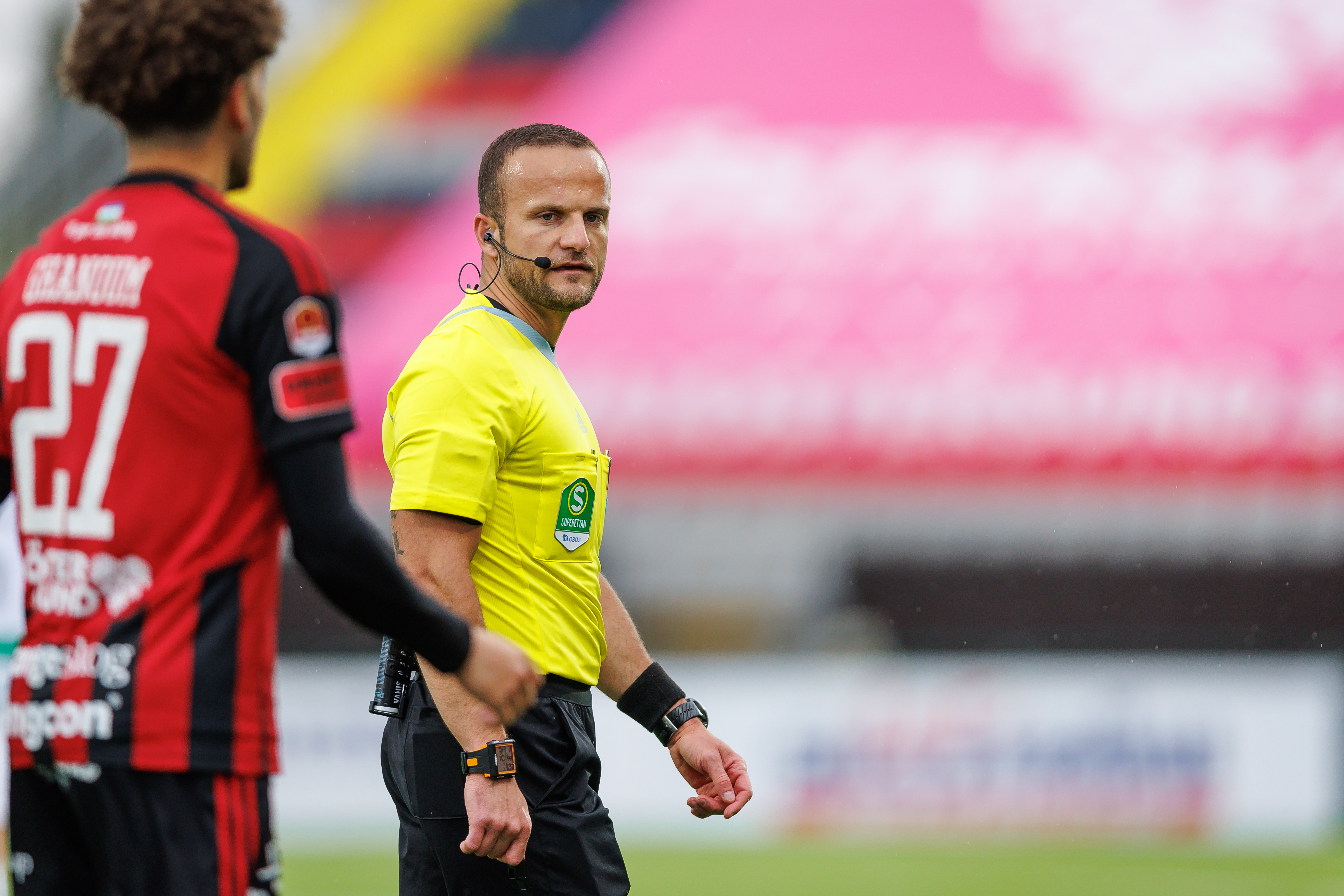
Interview: Rinon Hasani – Elite Football Referee in Sweden 2025-09-26
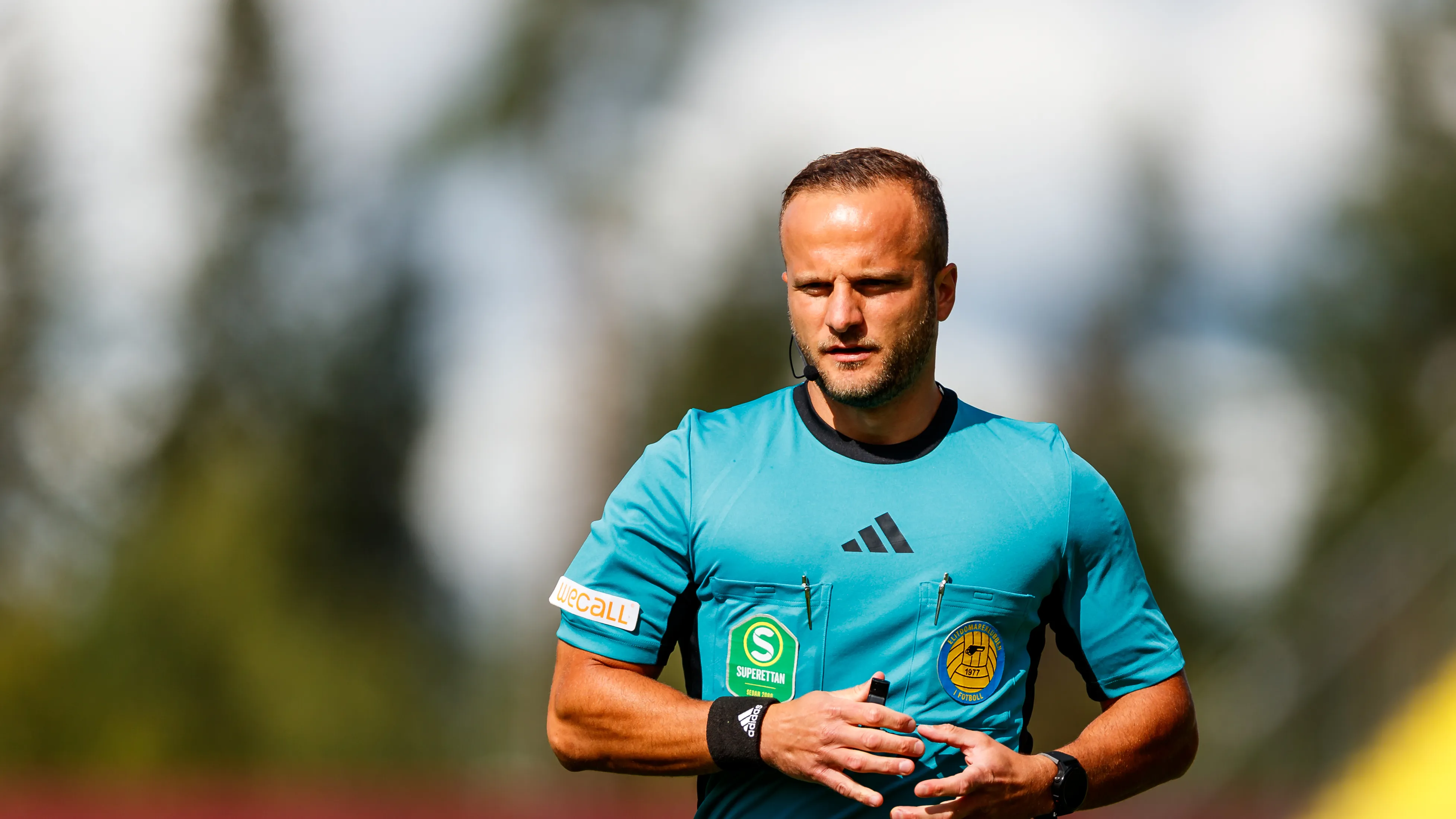
Interview with Rinon Hasani – Elite football referee in Sweden
Rinon Hasani has been refereeing football for almost two decades and is today a head referee in Superettan. The journey began as a club referee in Blekinge, where gift cards for football shoes were his first salary. In the interview, Rinon talks about what drives him, how he builds team spirit with his colleagues, and why he always kisses his lucky coin before the match. He also shares his thoughts on new rules and what it takes to reach the elite level as a referee.
– Hi Rinon. You referee in Superettan as a head referee today, but how long have you been a referee?
– Oh… in total. I’ve probably been refereeing for about 17 years. I started before I was 18 as a club referee, and when I turned 16–17 I started as a district referee. I remember I didn’t have a driver’s license when I started refereeing division 6 and reserve team football. I know my dad drove me to matches in the beginning.
– Do you remember why you started refereeing?
– In the beginning, it was to help the club, as a club referee. You also got paid quite well, which they advertised with, around 300 SEK per match you know. I was also a player in the club and thought “Well, what the heck, I can help out a little because it’s fun and at the same time make a bit of money from it.” I also remember you didn’t get money in your hand, but a gift card at Team Sportia so I could buy the football shoes I wanted and other things. In other words, I started refereeing partly because it was fun and because I earned some money from it.
– Do you remember now how it felt to referee back then? Did you already then felt that this suited you?
– It was fun because at first you got to referee kids’ football, those who had just started playing, then 9-a-side and later 11-a-side. Then I jumped in and refereed the women’s team, and I got motivated by improving and getting better games and more challenges. That’s why I wanted to keep going and climb to the next step all the time.
– What has helped you climb these steps over the years?
– I remember when I was refereeing as a club referee, there was a guy at school I knew, my age, who was refereeing me when I played in division 4. I asked him and said, “You’re already refereeing division 4, at your age. How do I do that?” Then he said I had to take a course to become a district referee first. So I wanted to climb up there too, both because I thought the referee role suited me and because it was fun and I could earn a bit more. So I called the referee association and signed up for the course in Blekinge and took the course. Then I started refereeing senior football.
– But if someone, just like you did, looks up to you and sees you as a role model. What would you say to that person or referee if they ask how to reach the elite level?
– Then I would give the advice to younger referees… that I’ve been refereeing for many years and to always take one season at a time. Find that continuity, give it your all, train hard, and take your refereeing seriously no matter what level you’re at today. It’s going to take a long time to climb. I see many referees who start for a year or two and think they can fly through the divisions but don’t get quick results and then choose to quit. What I think helped me climb upwards is patience. I usually say: be serious, but be prepared to put in time and effort for many years.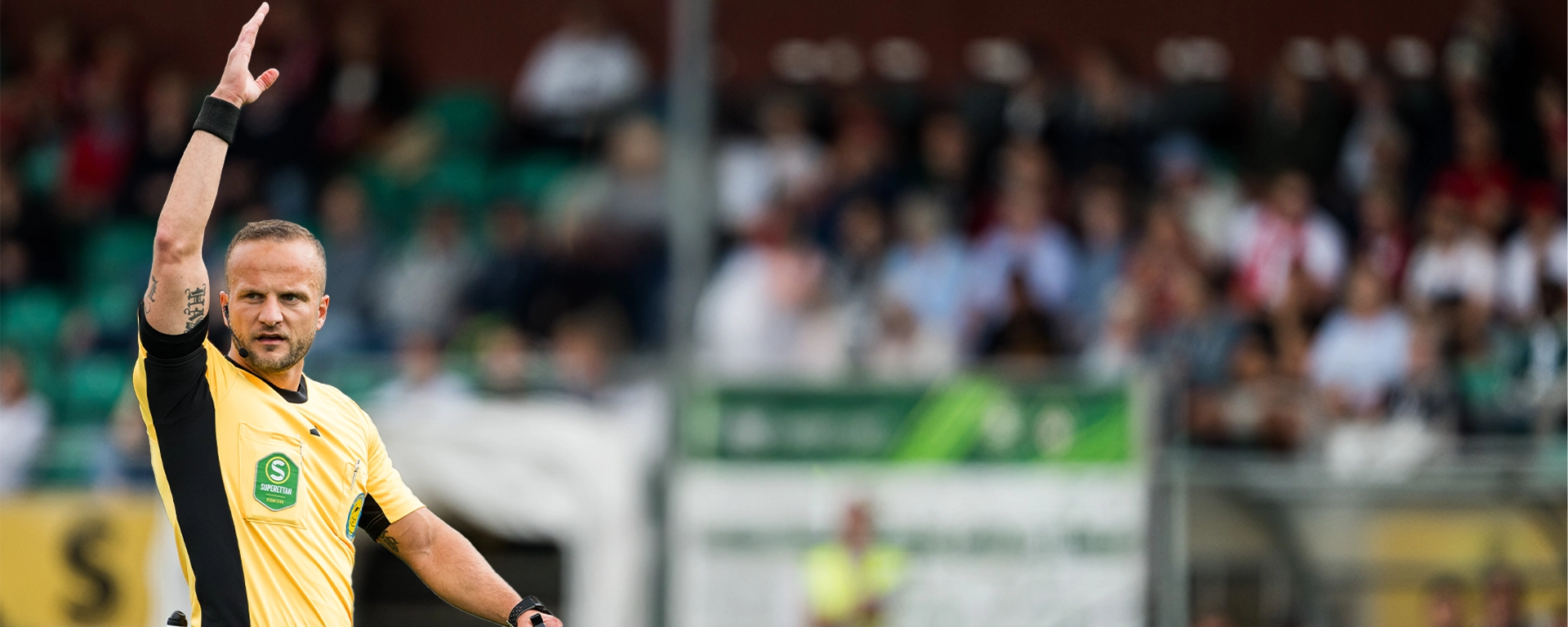
– Let’s change track a little. Before every match, you have a pre-match talk. How do you usually set it up?
– Absolutely, every match! I like to first and foremost create a sense of team spirit. That’s very important to me. That everyone knows they are part of the team. It may be me who is the head referee with the main responsibility and the whistle. But I like my assistants and my fourth official to dare to say what they think and feel to me. I encourage that a lot. That we have an open atmosphere in the team, even if we don’t always agree on everything. I always want to know their gut feeling in situations and what they think. That’s the foundation of my pre-match talk, that everyone feels involved and has an important role. Then there are details we always look at, such as the teams, players, conditions like weather, table position, top scorers, potential troublemakers… that’s the kind of structure I usually set up. First create team spirit, already long before the match, and then move on to details that vary from game to game. When you referee in Superettan often you get to know the players and coaches, and you also watch their games before. You try to find patterns in their play and other things so that you are prepared. Then I always try to go in as neutral as I can be, but prepared. For example, you need to be prepared that a certain player often approaches the referee with opinions. I’m prepared for that, and in those situations, I try to prevent things from happening and have as good a dialogue as possible with everyone. That’s also always part of my pre-match talks.
– Many referees have rituals before matches. Tying shoes a certain way, doing things in a certain order. Just like some players. Do you have something like that?
– Hmmm… nothing really. Or yes, maybe. I got a lucky coin from my kids as a Father’s Day gift. I always kiss that coin before going out on the pitch. That coin is always in the bag with the whistle at matches. I always kiss it. It says something like “You’re the world’s best dad…”, and it has kind of become a thing for me to always do before I go out.
– A referee is a referee, but also a human being. And every referee is unique in their own way. What is unique and what stands out about Rinon on the pitch?
– My main strengths over the years have been my match management, I’d say. Together with the physical part, which has always, or often, been good. I’ve of course continued to develop those two things to become as good as possible. I was quite a hot-tempered player myself, and what I hated as a player was having an angry referee. When I was angry as a player and the referee responded in the same way. I always try to meet players and coaches with respect and calm situations down. If someone approaches me very angrily, I respond with calm body language to de-escalate it. So match management, handling players, and physical fitness probably stand out about me on the pitch. I’ve played a lot of football myself and always had training and physicality in me.
– What do you think about the “new” 8-second rule for goalkeepers? You’ve been using it in Superettan for a little while now.
– I had a discussion with my referee colleagues during a match recently about that rule. I think it’s good! Maybe it’s not that important at the beginning, when it’s 0–0 and no one wants to waste time. But as soon as one team is leading and the goalkeeper starts holding onto the ball, then you just raise your hand and start counting down. Of course, no one wants to give away a corner kick against them. So I really feel that we’ve gotten rid of the problem and the complaints around it. So no, I think it’s good. You notice that goalkeepers are aware of it, and as soon as one team is leading I notice that I use the hand signal and count down much more. But it also creates better flow and gets the game started faster. It’s been an effective rule improvement, no doubt.
– And also that only the captain is allowed to talk to the referee, you’ve had that for a while. What do you think about that change?
– Same thing there, I think it’s an improvement. If someone comes up and talks to me, I usually have the rule that I say, well, I’ll take it with the captain. Then they usually accept that and drop it. And I also think that this and the 8-second rule, which we think are good, that we as referees in the higher leagues must follow and enforce them. Because in the end it’s the ones who watch these matches, kids, youth players, coaches in lower clubs – they are the ones who will play in these leagues in the future. That they learn from the start and that it becomes part of youth football over time, and they already have that “culture” with them as they move up.
– The season in Sweden is soon over. What do you do during the winter?
– During the winter I try to spend as much time as possible with the family. It’s really nice to have free weekends then, and we can do things, travel, plan activities and just enjoy. Spend as much time as possible with family, but also quite a lot of training off-season. I sometimes get invited to referee the local championship here in Ronneby where the local clubs fight for prestige indoors. So I usually take part and referee indoors, it’s fun.
– Good luck Rinon, thanks for this!
– Thank you!