
Interview: Matthias Modig National Referee Developer 2024-06-18
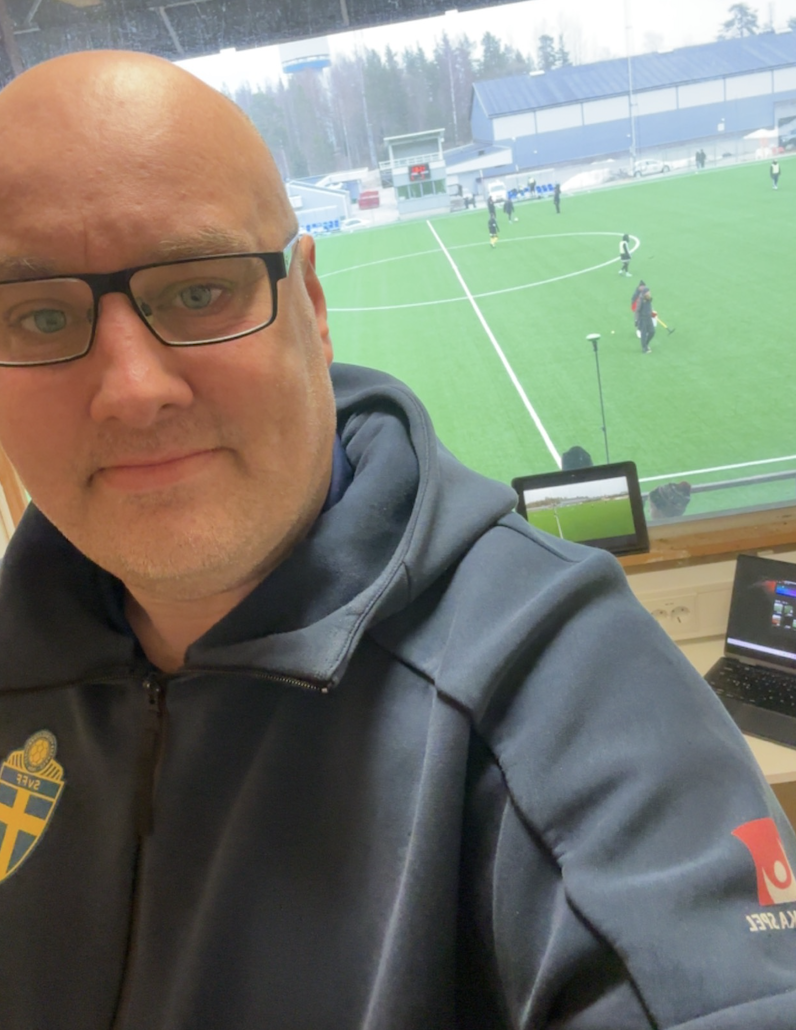
Interview with National Referee Developer Matthias Modig
In this interview, we meet Matthias Modig, an experienced referee developer from Örnsköldsvik. Matthias has had a career as a referee in both football and ice hockey and is now a National Referee Developer and also educates referees. He shares his insights and experiences with us. We follow his journey from being a referee to now being a National Referee Developer (NRD). Matthias also discusses the most important qualities a referee should have and how to best develop game understanding. Learn more about his work, challenges, and tips for future referees.
– Hello Matthias. Who are you?
– Hello, yes, my name is Matthias Modig, I am 46 years old and I am from Örnsköldsvik, North Sweden. I used to referee football, but for the past 10 years, I have been educating referees and working as an observer. Starting this year, my work with observations and education has become more concrete, where I have had the opportunity to join the NRD group and learn more there. That’s a brief introduction about me. And during these 10 years, I have served as LRO, RRO, and also CRO, which are simply different levels of observer, from local to central
– Right, quite a few abbreviations there. NRD, can you tell us more about what it stands for and what it entails?
– It stands for "National Referee Developer". Essentially, it involves educating referees at the regional level and above. I also educate LRO and observers at the local level, meaning Local Referee Observer, and to some extent, RRO, Regional Referee Observer. I also assist with various step-by-step training programs. It’s a new level for me and a step up from the district level. I find it very inspiring!
– If we go back to when you were a referee, Matthias, can you briefly take us through that period until now? How did you get onto this path?
– I originally come from ice hockey and have been an ice hockey referee; actually, I still do that, but somewhere along the way, I felt that being a referee was fun and I wanted to do it all year round. So, I took up football in the second half of the year. This was around 2002. A minor motorcycle accident that resulted in a troublesome body and problematic knees ended my refereeing career, and over the years, I transitioned into educating referees instead. I realized that I enjoyed that too. That’s basically how I got onto this path.
– National Referee Developer, how did you get into that role?
– Well, I took the long way, starting by training our club referees as absolute beginners, then moving on to the district, and now to the regional level. What I am passionate about is supporting, helping, and developing referees. The observer role is the one I’ve always found the most enjoyable. I don’t quite know how I ended up in the NRD role, but it’s probably a matter of being in the right place at the right time and someone appreciating my seriousness and commitment. I always try to be well-prepared for all assignments, just as a referee should be in their role before a match. But being able to follow the NRD group throughout the year to see and learn is very rewarding, as there is such an incredibly high level of competence and experience in that group.
– When you were a referee and had an observer at your match, what did you think about that role?
– I’ve always liked the idea of clarity. Being clear in everything you do. I appreciated observers who were honest and clear, which is something I’ve tried to incorporate into my own development. It’s extremely important to have a pedagogical ability and use it correctly so that my message gets through to the referee, and the referee takes the feedback, whether positive or negative, home to work on it. Don’t say one thing and write another in reports, and so on. That’s incredibly important. Just as referees deal with people on the field, as an observer, I also deal with people – the referee is just a person, right? Not only a referee. An honest and good conversation is something I’ve tried to carry with me in my role as an observer.
– A referee should possess many good qualities, and we are all different. But which qualities in a referee are most important to you as an observer?
– In all situations, it’s physical fitness. That’s number one, every day and in every situation. Then there are many other things, of course. After physical fitness, game understanding is important, and using your fitness and game understanding together in a right way. What you know about football, translate it into movement patterns, learn and see how two teams play football – use your game understanding and move according to expected situations. After that, knowledge of the rules is also crucial. The license to even be a referee requires that you pass the fitness test at your level and the rule tests. Packing your backpack with skills and experience takes varying amounts of time, but it’s not something you do in 10 matches or even a couple of years – it takes time. I also like a referee who can be humble. You don’t reach the top overnight; you have to work hard and long. I also believe more referees should listen to people around them, whether they are instructors, observers, or coaches – we are all there for your sake as a referee and want you to become your absolute best.
– Is there a common thread you’ve identified as an observer, among referees, that all referees can work more on?
– I would say two things. Game understanding and match management. These areas include communication a lot. How do we communicate, when do we communicate, how much do we communicate, with whom do we communicate – important things. Another common thread is identifying potential issues and creating good relationships on the field. That will make your match journey easier. To be a good referee, you need to understand football. Always look at the level above you. How are the matches played there, and how are they refereed? I hope everyone’s goal is to constantly reach the next level. So, as a referee, you must look there too. In other words, game understanding and match management, and in match management, we include a lot of communication.
– In Sweden, at least at the lower levels, you referee as the main referee, in the middle, at one level and go as an assistant at a higher level, or two. So, you watch matches and the referee quite a bit during those matches, right?
– Yes, before you specialize, here in Sweden at the regional level or higher, you can learn a lot as an assistant referee in those matches from the referee, as you said. That’s an advantage, yes. There you can get a lot of tips and advice, both good and bad, when you follow more experienced referees. I think it’s a lot about being there and daring to analyze afterwards. If there are video clips, which there often are nowadays, watch them and analyze your performance. But you also have to understand what you’re looking at and what you can do better. Every referee must learn to analyze their own performance.
– Let’s talk about movement patterns. Movement patterns for referees have been tweaked over the years. What do you think about movement patterns?
– Here I think that it requires a lot from us observers, and we must first understand this ourselves to teach it. Now we talk more about corridors, outer, inner, and which play areas we are in. To be able to teach this to referees, we as educators and observers must first understand it ourselves. And that’s certainly a challenge. I believe that, once again, analyzing and watching a lot of football is a winning concept. When something happens, why does it happen? Both good and bad things. In which corridor was the referee when this happened, for example. It’s very difficult to see everything live once. Sometimes you have to rewind to learn something from it. And then we learn more about corridors, areas, and positioning. Another important thing is always to think about what will happen next. Don’t get too focused on where the ball is now, but where the next situation will arise and take a possible position based on that. Simply read the game.
– If a referee hasn’t played football their whole life, how do they gain better game understanding?
– This is very difficult. But my biggest advice is to have someone to discuss things with. You don’t learn game understanding if you don’t understand what is good, bad, right, or wrong. Have someone experienced to discuss things with. It could be a referee coach, colleague, instructor, or similar, but have someone to talk to about decisions, positioning, and everything else. This is very important to create an understanding of why things happen the way they do. Referee coaches have a very important role in this. An observer is only there for that match, your referee coach is with you all year or even several years, and you need to discuss why things happened the way they did. To reach the top, or higher than you are today, it’s not necessary to have been a club referee for half your life or to have played football – to have that game understanding. You can train it, that’s my message. You might need to put in more hours compared to someone who has played or refereed a lot, but that doesn’t prevent you from climbing up.
– Observers often talk about self-evaluation for a referee. How important is it to be able to do a good self-evaluation after a match as a referee? – For me as a coach, it’s extremely important, maybe not as important for observers, but it’s certainly good to have a good self-evaluation. But for me as a coach, I have a task to develop the referees further and maybe see a referee a few times or several times a year and can provide some tools at those times. Then the referee must learn to handle those tools and tips they get from me or an observer, and to work with them correctly requires experience but also the ability to see oneself from other perspectives. You must take the feedback and work on the self-evaluation. Analyzing why things happen or turn out the way they do in a match is an important role that an observer and coach have; we do it to help the referees. Not just what is right or wrong or good or bad. Our role is much more than just saying what was wrong; I must be able to give a referee tools that allow that referee to do it right or differently next time. And to be able to do that well, you as a referee must understand this and understand what you are doing right or wrong and work further on those things. But my analysis of the match can be very important for the referee to continue packing that backpack with experiences.
– And that’s where the pedagogy of an observer comes in. Saying what a referee does right or wrong may not always be enough, right?
– No, exactly. Here comes an important part for us, as you say, the pedagogy that I mentioned earlier. We work with open questions to the referee, which makes the referee take in things better and creates this joint analysis of the match. I always work with many open questions, why things turned out the way they did and some questioning, which leads to the goal for me, which is answers and solutions to things, both good and bad situations. We don’t always have the solution when we sit in the dressing room after the match; sometimes we need to talk the next day too. Another example of a solution is that I might ask a referee to try some tools, for example, a different position. The referee tests it in the next match to see how it feels to create better conditions. There are no right or wrong answers here either; we need to work things out together, and our pedagogy is very important.
– Thank you for this, Matthias, and good luck with your mission.
– Thank you, and I want to leave a couple of messages for all referees. Be humble about your assignments and matches. Be as well-prepared as you can, have the fitness and rule knowledge in place. Remember that mistakes will happen, but have someone to discuss them with and listen to those around you. There will be tough periods in your life, both as a referee and personally, but it’s important to have someone to talk to about it. And final tips: Watch a lot of football!