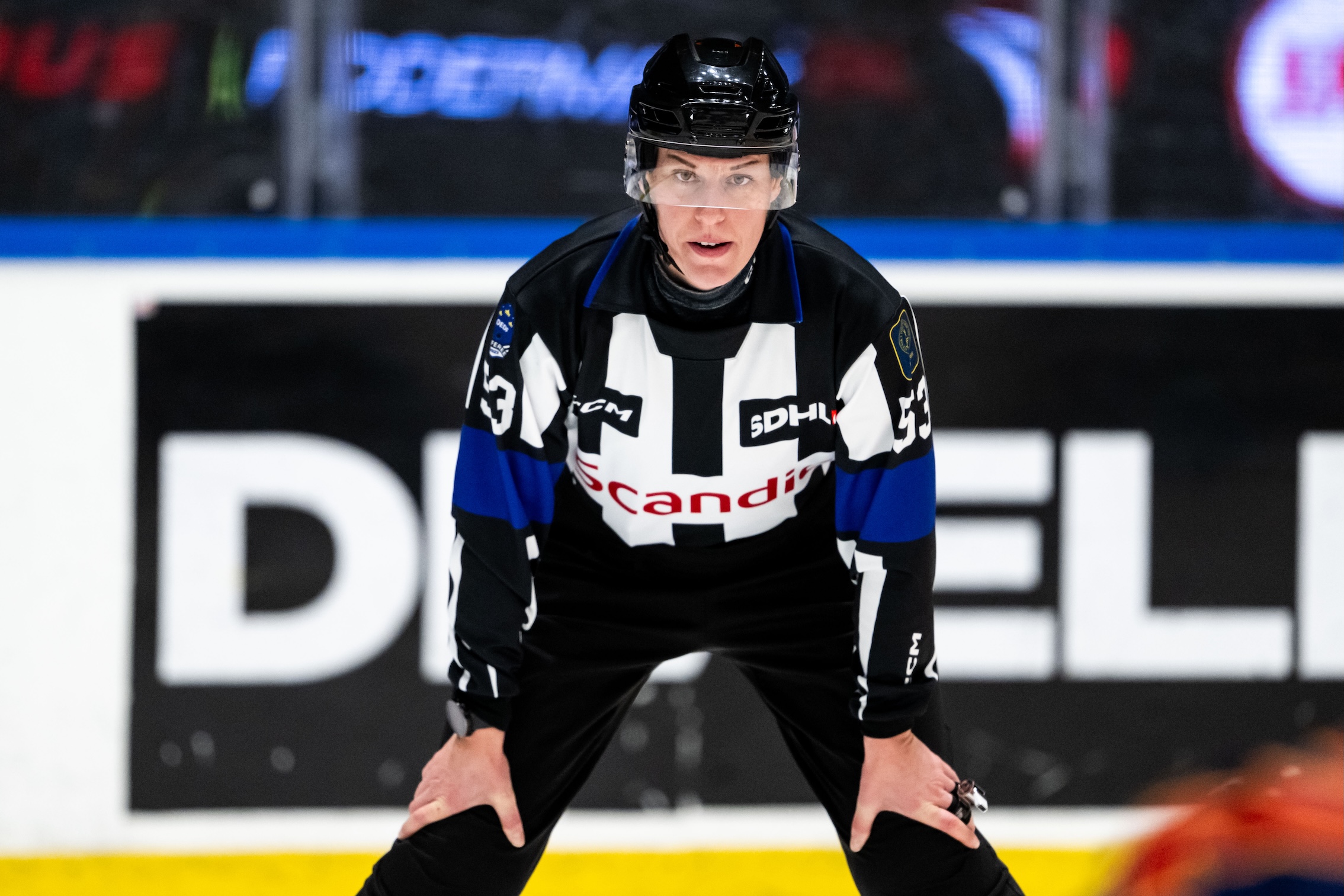
Interview: Ice Hockey Referee Veronica Lovensnö 2026-08-25
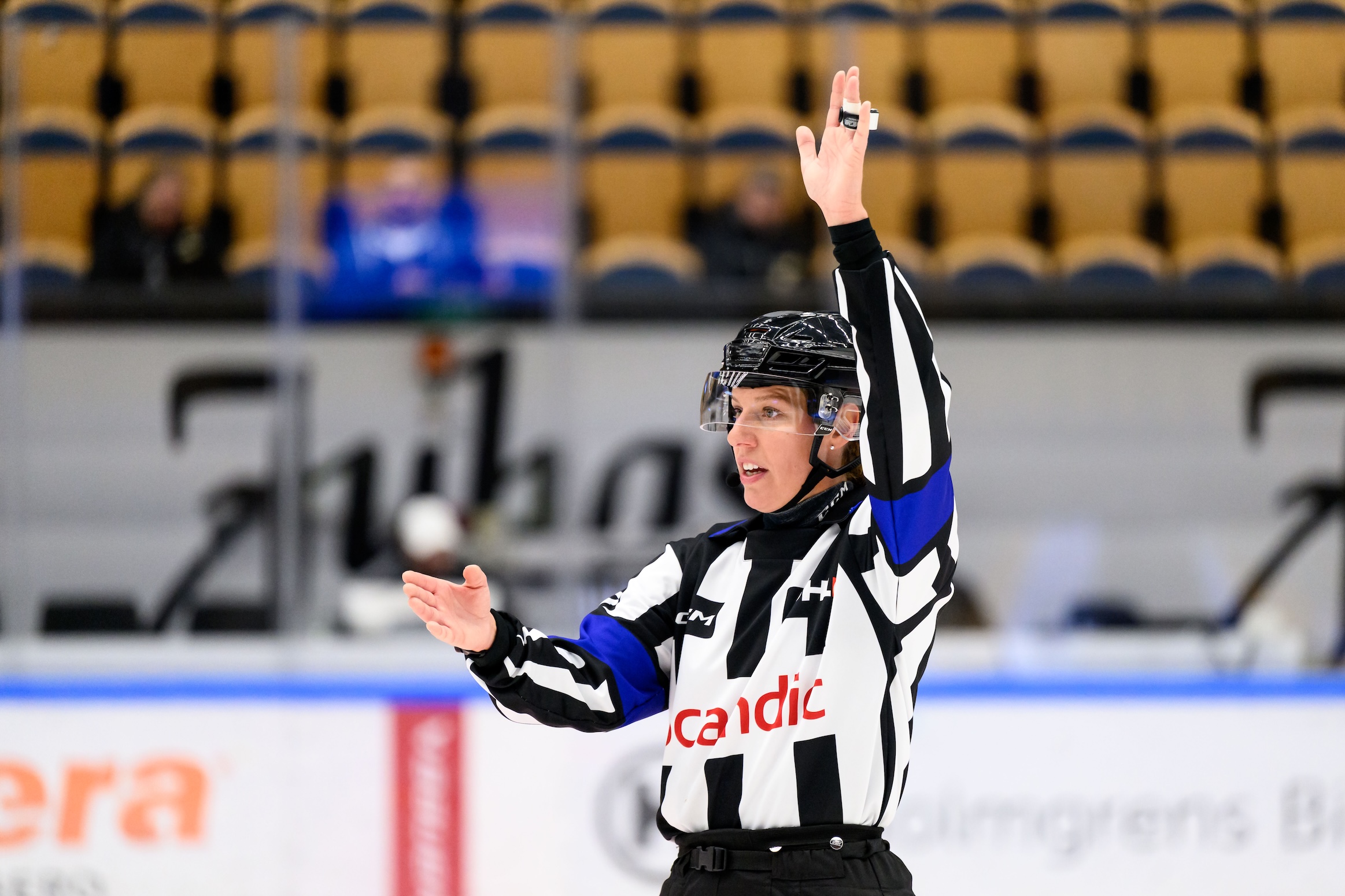
Interview with ice hockey referee Veronica Lovensnö
How do you become a really good referee – and what does it take to officiate games at the highest level? For ice hockey referee Veronica Lovensnö, the journey began with a playing career that ended prematurely but opened the door to a new path within the sport. Today, she officiates at elite level and knows how important leadership, communication and trust are out on the ice. In this interview, she talks about her journey to the top, what was most difficult in the beginning and why the relationship with the players is one of the keys to good refereeing.
– Hi Veronica. Before we get started, I’m really curious to hear what you think about Spintso Refcom II Pro. The first season in the SDHL with the system is now complete, and you’ll soon be heading into the 2026/2027 season. How does the system work?
– It has been very good and positive. I’m surprised by how easily my colleagues and I got started with the communication system and that way of thinking. We’ve also had the opportunity to officiate with SHL referees, who are used to using communication systems, but we’ve adapted well to the new way of thinking. I only have positive things to say about the system and how it has worked for us.
– Okay, what made you start refereeing ice hockey?
– I played ice hockey and moved to Linköping after graduating from high school. Then I suffered too many concussions and had to stop playing. By then, I had already tried refereeing a little and got to attend a “camp” quite early on with other female referees. There was a girl there called Malin Skotte who told me that as a referee you can get the opportunity to travel abroad and referee hockey. I thought, “That’s cool, I’d like to do that too!” I don’t think I had ever considered that you could have the same goals as a referee as you do as a player. To make the national team, take part in the World Championship and maybe even eventually an Olympics. That’s when I realized that I could actually achieve those things as a referee too. This was in 2010, and I was 22 years old. So, in short, I started refereeing because of injuries as a player, and by chance, I would say.
– What did you find difficult when you first started refereeing?
– The difficult part is leadership. Suddenly I’m supposed to go in there, make decisions and talk to the players in a new role. I didn’t do that at all as a beginner, not the way you do today. Blowing the whistle and calling icing and offside is something I think many, if not all, players could manage without blinking. But match management and building relationships with the players takes time, and that was difficult in the beginning. How do you do it, and how do you get better at it... yes, that was difficult.
– So how did you learn it? Any tips for other beginners?
– Just challenge yourself. Step outside the box. Try what works, find a player or coach you’ve made a bit of a connection with and find your way in through that. Sometimes it’s difficult to connect with the players because they’re focused on what they’re doing and their adrenaline is through the roof. But you have to keep working on communication and constantly look for different kinds of relationships that you’ll have with different types of players or coaches. It becomes easier to referee and make decisions if you have a relationship with the people you’re officiating. Sometimes that relationship isn’t mutual, or particularly good, but you can still speak to the player with respect.
– In ice hockey, as in other sports such as football, you rarely see referees talking that much or for very long with the players. Isn’t it difficult to judge when to have a dialogue and how to approach it? In ice hockey, it feels like those conversations are quick and brief.
– It varies, depending on the game and when it happens during the game. Is this the right time to talk to a player, or should I deal with it later? You constantly have to consider whether the conversation is worth having, what has happened, whether I should enter into a discussion here or whether it’s simply complaining. We’ve said that we shouldn’t have too much dialogue with the players because the game is the priority and the game has to keep moving. It’s a choice you have to make, but it shouldn’t affect the game too much.
– Players or coaches can often approach a referee in many different ways, and perhaps you sometimes wish they were a little more self-critical about how they approach a referee. But has there ever been a moment when you, as a referee, felt, “Oops, I handled that player or coach the wrong way”?
– Yes, but I think it depends a lot on what kind of person you are. If you’re a very competitive person or have a lot of adrenaline, that obviously affects things. During the years I’ve been refereeing, I’ve learned that it’s not always worth going in with that approach. It’s not always worth being hard and aggressive. It’s often better to go in with a softer tone and really think through what you’re going to say and how you say it. The best thing is to communicate when you actually have something meaningful to say, something concrete. And as a referee, you have to try things out and see what works. So yes, to answer your question, I’ve experimented a lot over my years as a referee, and some things have worked while others haven’t.
– Today you referee in the SDHL, men’s Division 2, J18 and internationally. What has your journey to the SDHL looked like?
– When I started refereeing, there were very few female referees and my playing career was short. But there was a shortage of referees in Östergötland, so I attended an additional district referee course they had arranged. After that, they said, “You’re refereeing in Riksserien next weekend.” To which I replied, “No, I’m not.” But that’s what happened. I was thrown straight into the deep end and I’ve stayed there ever since. Riksserien is now the SDHL, although the name has changed a bit. So my journey was fast, and I’ve had to learn along the way. It has been educational for me to referee a mixture of women’s and men’s hockey, and I’m still developing by doing that. Riksserien was very new back then, and today I probably wouldn’t have been able to start the way I did because the league has developed so much. Now you definitely need more routine and experience if you’re going to move up and referee in that league.
– When you were a new referee and went straight into the top women’s league, what feedback did you get from observers and people around you about what you needed to work on and develop as a referee?
– When you’re new, it’s very much about the overall picture, and I just absorbed everything they told me. Some coaches or observers focus more on the overall picture and others on details. It could be things like how to hold the puck when dropping it as a linesperson or how to stand. Or how I should make a wash-out signal, how far from the boards I should stand, that conversation I had there I shouldn’t have next time, or the conversation I didn’t have I should have next time. It covered everything, big and small, and I just absorbed as much as I possibly could and worked on all those things to put the whole package together. I’m now a referee but have also spent several seasons as a linesperson.
– So how should you do a wash-out?
– Straight arms! A little way in from the boards.
– If we take a football referee team as an example, it’s one referee team and perhaps not so much a team within the team. Ice hockey, on the other hand, has more clearly defined teams within the team. You’re one officiating team, but also teams within that team, where the linesperson form one team and the referees another. You also use Refcom II Pro in the SDHL, where the linesperson have one channel, can hear the referees and can talk to them using the PTT button, while having open communication between the linesperson. And the referees can hear and talk to each other – two different channels but still within one system. How would you describe this cooperation between the teams during a game?
– Cooperation between the teams, and within the team, is incredibly important. It’s an interaction that has to work. Especially now that we use a four-official system in the SDHL – not in every game, but often – and hopefully we’ll use the four-official system in every game next season. But when there are four of us, everyone has to be on the same level when it comes to decisions, everything involving offside, icing, penalties and match management. There’s a lot of communication both before and during the game. How do we solve things, how could we have done it better and how can we develop it even further? Those are things we sometimes discuss during the game, but also during intermissions and after the game, of course. But I would say the most important thing is the interaction. All the officials have to find each other’s level for us to become a good team, and teams within the team. The interaction and communication between the linesperson is one thing, then between the referees is another, and then between all four is another – not an easy task when you sit down and talk about it like this. Then we have the communication system, and we use Refcom II Pro from Spintso, which makes an enormous difference in both the three-official and four-official systems.
– If we put ourselves in your position in a three-official system, as the only referee. What’s the most difficult part during a game?
– It’s when there’s a counterattack and I have to leave what’s happening behind me. That’s when you place a lot of trust in the trailing linesperson. Then there’s the fact that you have to keep track of the entire rink when you’re on your own, which is a challenge. Keeping your focus in front of the net while something might be happening above the slot at the same time – that’s when it’s useful to have split vision. I’d say that’s probably the hardest part: managing to cover the entire area and see everything.
– Okay, and when there are two referees instead. What becomes the challenge then?
– The absolute hardest thing is covering the neutral zone during play. That’s when you switch focus and areas, when you switch who follows the puck and who watches the rest of the play. That requires good interaction between the referees. The neutral zone is the area between the two blue lines.
– You briefly mentioned the communication system. You didn’t have it before, but now you use it in every game. How does it help you, and how does it affect the game?
– I think it’s a very useful tool. Like we talked about earlier, you can constantly check with your fellow referee about where we’re looking and which areas we’re covering. At the same time, the linesperson receive that information and can pick up an area where we might not have coverage at that particular second. It has definitely created a sense of security. Even though we have a “manual” to follow regarding which areas we should cover and watch, it doesn’t always work 100% that way during a game. You can also get those little confirmations that it was a tripping penalty, that the stick actually made contact with the skate or whatever the situation might be. It feels like the communication system brings the whole team together.
– Let’s go back to positioning and movement patterns. How do you work with that to simply get the best possible view?
– All referees are a little different when it comes to standing still or staying in motion. There are advantages and disadvantages to both. I like to keep moving all the time, so one piece of feedback I sometimes get from my coaches is that I need to be a little more still. But fundamentally, it’s about reading the play and finding a position where you can see the game best. As a referee, you have to put yourself in a good position before it happens, before that situation develops there. Sometimes that’s easier said than done. Sometimes you read the play a little wrong as a referee, or there’s an unexpected change of direction behind the net and you end up in the corner as a referee, stuck in a crowd where it’s tight and right in the middle of the play. Then, as a referee, you just want to get out of there. Afterwards, you have to analyse a situation like that and consider whether you could have changed position earlier. That’s where the question of constant movement or not comes in. If I’m already moving a little, it might be easier for me to escape that kind of situation earlier and put myself in a better position, but if I’m moving, I might instead miss a situation that’s happening right there and then.
– And in those situations, an ice hockey referee also has to make quick decisions. How do you handle a high tempo while also having to make fast and difficult decisions?
– Of course you want to make a decision as quickly as possible, but sometimes even we referees and our brains need to process what we’ve just seen. If I use tripping as an example, my brain has to work out whether the stick hit the skate or whether it was a “toe-pick” in the ice. That can take a second, or a few seconds. You have to have the courage to raise your arm one, two or three seconds later than you would have liked. Being able to do that is a strength because it helps you get the decision more correct. For example, the play might continue, there might be a shot on goal or a counterattack, and that’s when you raise your arm. Those are sensitive moments and big decisions to make, and you have to have courage. Sometimes very quick decisions are required, and that’s something you develop and get better at the more you referee. If you’re in the crowd or watching as a supporter and see a decision like that, the reaction is often, “Ah, you’re only calling that because they’re shouting,” but really it’s just me as the referee needing an extra second to quickly process what I’ve just seen, ultimately to make sure. Believe me, as a referee you know when you make a late call, but it’s better that it comes late than not at all. We referees are only human. We have to process what we’ve just seen, raise the arm, blow the whistle – quite a lot can happen in just a few seconds.
– What has being a referee given you, both on and off the ice?
– Looking at my refereeing career, I’ve had the privilege of having the whole world as my workplace. I’ve invested a lot in my refereeing, and that’s what has taken me to where I am. The World Championships in the USA and Canada are probably the highlights, and I would never have been there if I hadn’t been a referee, plus the Olympics in South Korea and China. That’s something I’ll carry with me for the rest of my life. As a person, I’ve developed my leadership skills and learned to have the courage to make tough decisions, even in my private life, and to trust myself. You absolutely grow as a person and as a human being through refereeing!
– If a player, or someone who doesn’t play, reads this and starts thinking about becoming a referee, what would you say to that person?
– I say GO FOR IT. If you play ice hockey, it will benefit you as a player too. Knowing the rules and having the courage to make those decisions will give you a greater understanding of hockey and the game itself. You’ll also gain a much better understanding of the person blowing the whistle and what it can be like. I think trying refereeing can help a player a great deal. There are also many examples of people who might feel they’re not progressing any further in their playing career but still want to stay involved in hockey, and there are endless opportunities as a referee. So, go for it whether you play ice hockey or not.