
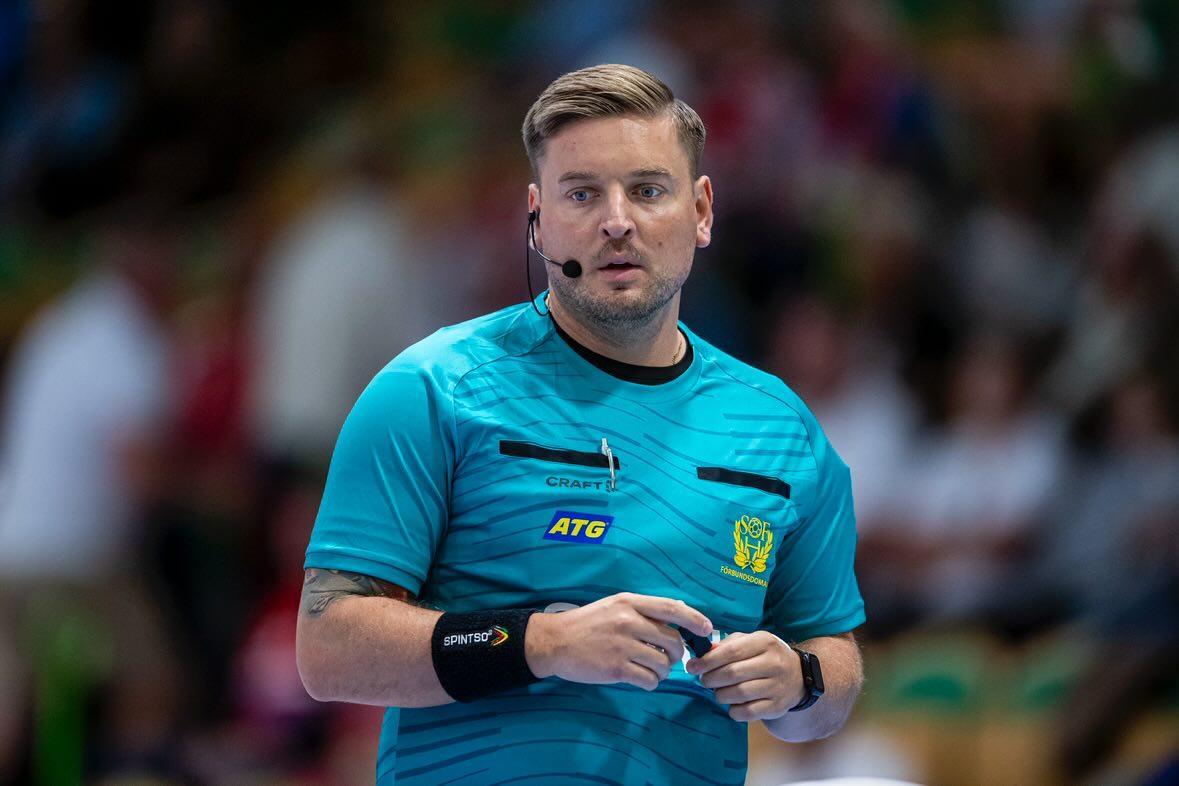
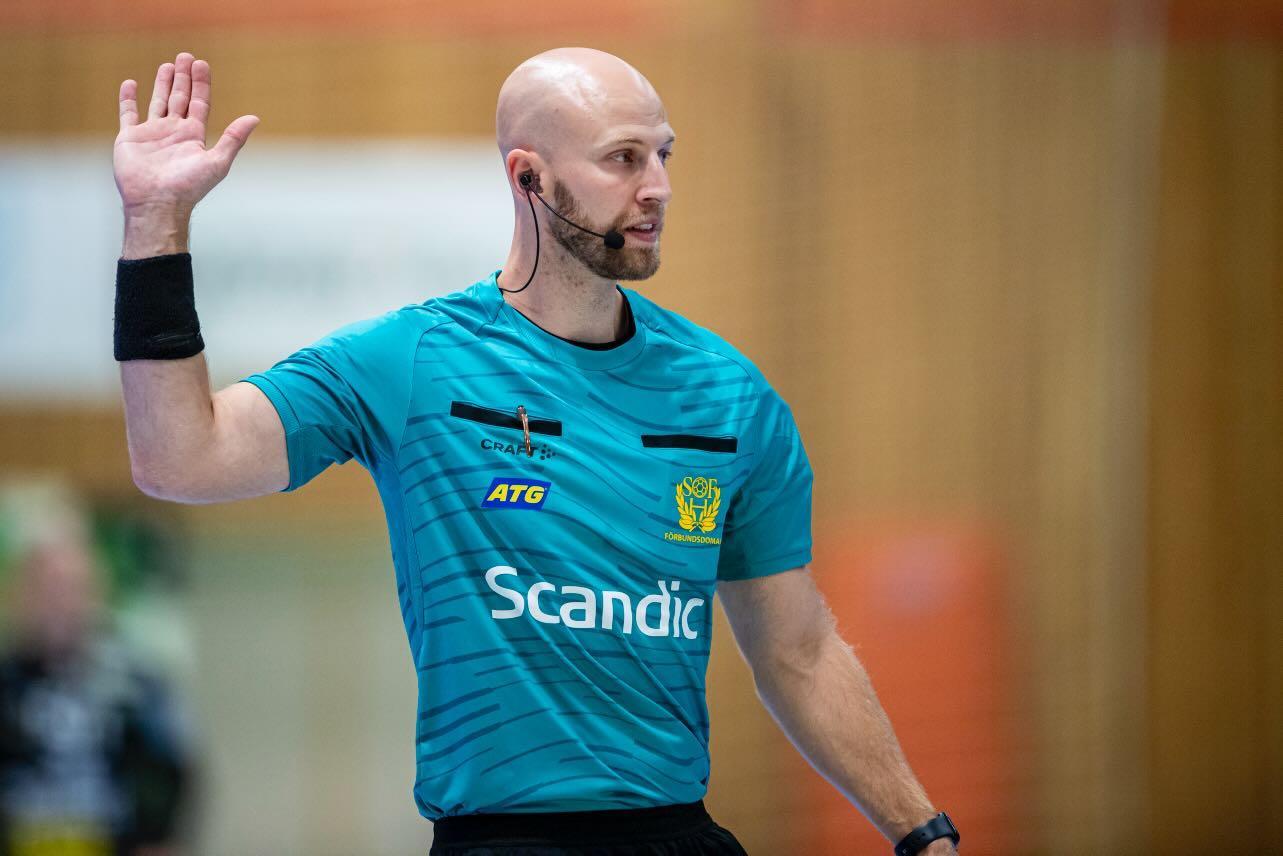
Interview with handball referees Darmin Zdenac and Johannes Lindström
The handball referees Johannes Lindström and Darmin Zdenac officiated their first matches together already as 13-year-olds – and 18 seasons later they still stand side by side on the handball court. From youth referees in Växjö, they are now aiming for the elite level. In this interview, they talk about why they love handball, what it’s like to be a referee in a sport that requires both focus and respect, and how communication with Spintso Refcom II makes a difference in the heat of the game. Read on to take part in their thoughts on community, challenges, and the drive to constantly improve.
– Hi! Could you start by briefly introducing yourselves?
– Johannes: My name is Johannes, I’m 31 years old, have two kids, and grew up in Växjö, where I still live. I work with ventilation as my main job, and being a handball referee is also a job, but more like free time and a hobby. We’re now entering our 18th season together as handball referees.
– Darmin: Yes, my name is Darmin Zdenac and I’m the same age as Johannes. Originally from Bosnia, I came to Sweden when I was 6 months old and I’ve lived in Växjö all my life. What else… I’m engaged and I do all sorts of things, kind of a jack of all trades. When it’s handball, it’s a lot of handball, otherwise it’s football, tennis, and training in many forms.
– So you were 13 years old when you started refereeing?
– Darmin: Exactly, we were 13 years old and both played handball in the same team. We played until we were about 20 and refereed at the same time. I quit playing partly because I wanted to focus more on refereeing, but also because I couldn’t keep up with my studies. So it was a combination of studies and refereeing that I chose to prioritize. Johannes, you kept playing one more season, right?
– Johannes: Yes, I played one more season in Division 2, but then I broke my hand and saw it as a sign to focus on refereeing with Darmin instead. And that’s how it continued.
– You started as club referees, did you always referee as a pair back then as well?
– Johannes: We always refereed in pairs. Nowadays you start with “mini handball” and then you referee alone. I remember there weren’t that many club referees back then, and it was hard to get kids and young people to start refereeing and continue with it.
– Darmin: If I remember correctly, parents often refereed mini handball, which we skipped, so we went straight into the two-referee system.
– What I’m getting at is that you’ve been a referee duo since you were 13 years old, right?
– Darmin: Johannes’ dad was a handball coach, and when I started playing a couple of years after Johannes, my dad also started coaching. We connected on a family level, as friends, and as referees, you could say. The other two guys who also continued refereeing were also sons of team leaders. But we were probably the only ones who really got into it and thought it was fun long-term. The combination of enjoying it and earning a decent amount of money as 13-year-olds made it easy to keep going as referees.
– Had your parents refereed before?
– Johannes: No, none of them had refereed before. Even as players they didn’t play very much, just a little. But they think it’s fun that we started refereeing and still referee today.
– Darmin: Haha, yeah, they probably realized early that we weren’t going to become professional handball players. Jokes aside, as I mentioned earlier I’m from Bosnia where handball culture is very strong, and I remember as a kid my whole family gathered around the TV to watch championships. So there’s always been a big interest in handball in my family. Handball is a tough but fair culture and sport, since you’re so close to the players, coaches, and audience. I didn’t think much about it back then, but it’s a really tough environment for young referees. You need to have a thick skin and endure. But today there’s a lot more mentorship, so it’s easier to get support early. That’s something I reflect on now that I’m a bit older.
– Johannes: Another important reason why we continued refereeing handball was the boost from hearing mostly positive things from other parents, coaches, and players. That keeps you motivated and makes it fun. It’s incredibly important to give young referees positive feedback – it really makes a big difference.
– Has handball come further than other sports when it comes to culture and working environment for referees? Compared to football, for example?
– Johannes: It can be tough on the court in handball too, just like in all sports. But in the handball community everyone knows each other in some way. People can understand each other’s roles and situations better, and it feels more like a family, with less distance between players, referees, and supporters. Even if you’re not a referee, there’s a higher level of acceptance, I think. Of course, sometimes things boil over in handball too.
– Darmin: Just to continue on the topic of respect – handball is a gentleman’s sport. You give a lot and you take a lot. On the court we are two match leaders who must lead the game. That’s also an art, to be a referee and show humility towards the players. We also have to show respect and acceptance, together with following the rule book – but still stretch it a little since it’s a sport of interpretation. As referees we must be able to explain why we made a decision, but also admit it’s our viewpoint, and maybe we’re wrong – but we go with it. Hopefully that gets accepted. Referees also have to give and take in communication with players. I think handball is at the forefront along with a few other sports. Over the years there have been constant rule changes, and that has helped the sport evolve and become faster. Even recent changes are meant to improve the flow of the game.
– What’s the best thing about handball? Why do you referee handball?
– Darmin: Haha, ask me again in 2–3 months and you’ll have the answer. When autumn darkness comes, it rains and snows, it’s not hard to referee handball indoors. I always say that when the handball season starts, that’s the first sign of why I chose to referee. But of course that’s not the only reason. For us it was a natural transition to stay in the sport by refereeing. In handball things are always happening – lots of goals, lots of duels, and you always have to stay alert.
– Johannes: We both love handball, we watch it several times a week. Our own matches, league matches, and European games too. But we referee because we love the sport and enjoy the role of referees.
– What’s the most challenging part of being a handball referee?
– Darmin: You have to stay focused at all times, in every situation, and be present for 60 minutes. It goes fast. After all, it’s only four eyes judging the match – but there are also countless eyes on the stands, on the court, on the benches. We often talk about blowing the expected call, which doesn’t always have to be 100% correct according to the rule book. What do the 1500 people in the hall expect you to call? Sometimes it’s easier to make that decision than to stick rigidly to the rule book. The most challenging thing is constantly being present and finding the balance between judging by the book and blowing the expected call, as close to the rules as possible.
– How do you work with positioning and communication during a match?
– Johannes: We’ve worked a lot with zone distribution. As a goal referee you primarily watch the pivot play. But if, for example, one team takes out their goalkeeper and adds an extra player, then we must communicate and help each other. In such cases, as a goal referee, you might take a broader position, closer to the winger. Without a communication system – we use Spintso Refcom II – it would be very difficult to help each other. It switches quickly. As a goal referee you’re also responsible for 7-meter throws, line violations, and when the shot comes you switch focus to the goal as well.
– Darmin: We aim to always be in motion, both as court referee and goal referee. But depending on the match, the number of players, and who takes a lot of shots, I might position myself more like a winger to get a wider view. Just like Johannes said. We use the headsets a lot, repeating things like “You’re alone, you’re alone, you’re alone.” Then Johannes knows he’s 100% alone in that situation and must take full responsibility when he runs with the counterattack. At the same time I have to find the right angle to see if there’s a push at the last second. It’s constant communication, where we have to find the right balance in what and how we say things to support each other and share responsibility.
– Soon it’s time for the season here in Sweden. When do you start and do you have a goal?
– Johannes: Our first league match is on September 17, I think. Before that we’ve already refereed some cup games, like the Swedish Cup. So partly we’ve already started with training games and cup matches. We’ve also had some elite pre-season games, both men’s and women’s. Our short-term goal is to move up to the elite level. Our biggest goal this season is to get a test match at elite level and take it from there. We feel comfortable refereeing the men’s second tier, but want to face new challenges. Of course, the higher you go, the tougher it gets – faster and more physical handball, and much larger crowds too, which is always fun.
– Darmin: That’s clearly our short-term goal. To reach it, we need to get closer to the elite referees and their way of managing a match. If you talk about technicalities like what is a suspension, what is a 7-meter throw – every elite referee knows that inside out. The biggest difference between federation referees like us today and elite referees is that they have more confidence to call the expected decisions. They’re also more confident in the zone distribution we talked about earlier. For example, a situation might end in Johannes’ zone, but I’m the one who needs to blow the whistle. Johannes can then give me input to make the call, since it started in my zone, making it easier to sell the decision. To reach our goal, I think we need to work on those details and that art to be fully ready for the next step.
– Last question. How important is the communication system for you?
– Johannes: It has helped us a lot! Really a lot. From our previous system, another brand, where we couldn’t hear each other well and it often failed, to now hearing each other crystal clear with Refcom II. Even with the noise in the arena, where we previously had a lot of issues, now we don’t. Before we had to shout at each other to hear – now we don’t need to. It’s an incredible improvement that makes it easier for us to actually lead and referee a match.
– Darmin: The best recommendation I can give to referees and colleagues who don’t use Spintso, but something simpler, is: if you want to take your refereeing to the next level, you must invest in a good communication system. Refcom II is truly a great communication system. Put yourself in a heated match, with two fan sections, 1300 people in the stands, music, loud atmosphere – and we can still constantly talk with each other. That gives us confidence in the match and in our leadership. It’s definitely made refereeing easier for us.
– Johannes: Before we finish, I think it’s important to mention the support we get from home. All the time you put in as a referee requires people around you to give good support. I have a very understanding partner who is also involved in handball and understands that during the season I’m away more than usual. That’s not a problem for us, but I still feel incredible support from home. It wouldn’t be possible for me, or us, without that support.
– Darmin: Very important, good that you mentioned it Johannes. In a way you sacrifice other fun things, some family time, friends… but it’s also important to separate our private lives from our referee lives. We need balance and support, which we really have. Also from above, in the referee organization, where we can say “this weekend I want to spend time with my family” and it’s okay. It’s about having a dialogue with referee managers, planning, and communicating. That support is also a tool that makes it possible for us to aim higher.
– Thank you very much! And good luck with the season.