
Interview: Handball referee Alice Watson 2026-05-22
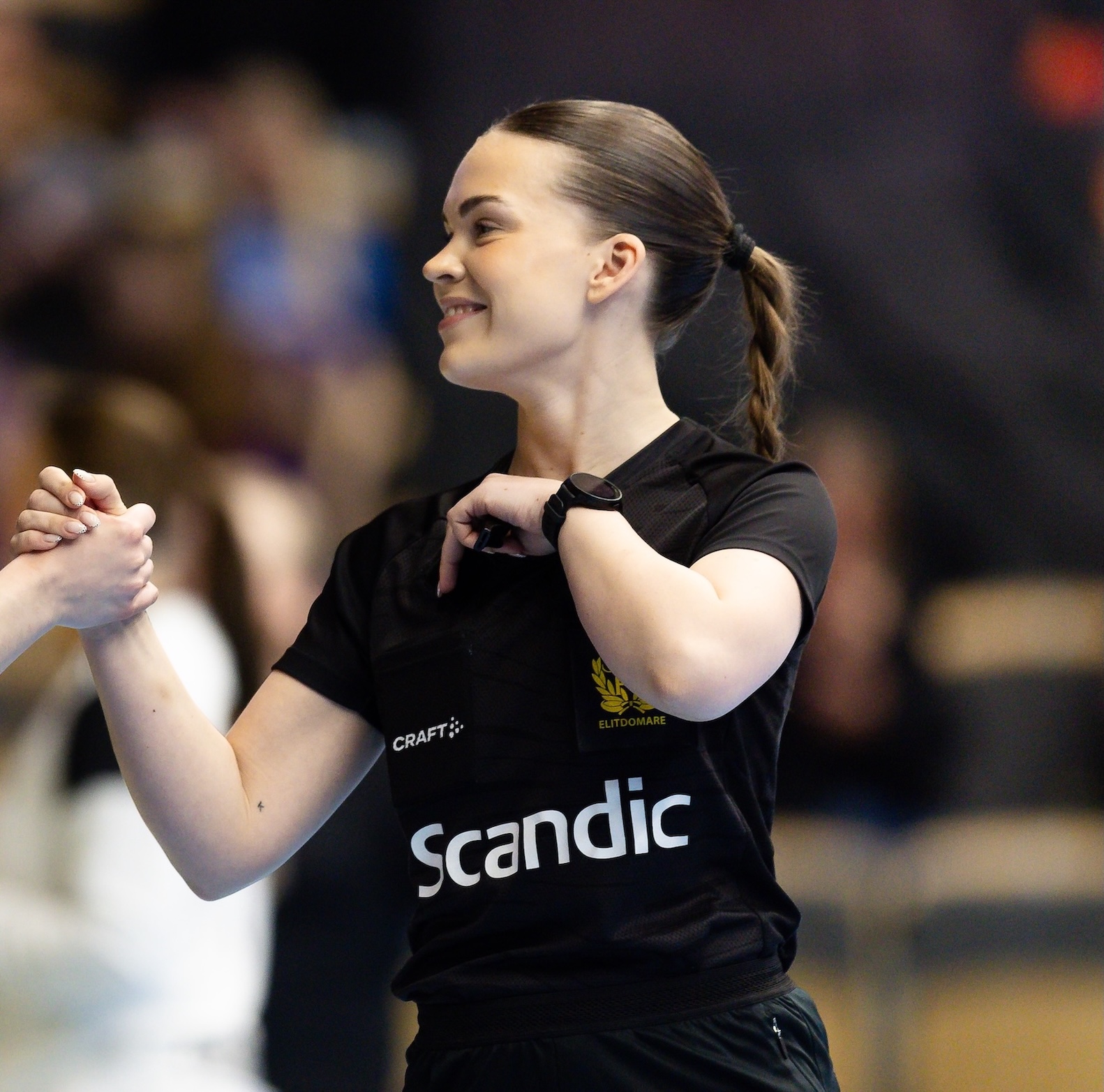
Interview with Elite Handball Referee Alice Watson
From working extra shifts in local youth sports halls to officiating international championships and Sweden’s top handball league. For Alice Watson, the referee career initially started mostly as a way to help her father and earn some extra money on the side. Today, she is one of Sweden’s leading handball referees — with a clear ambition to develop both the referee role and the working environment within the sport. In this interview, she talks about pressure, communication, support from home, and why more people should dare to try refereeing.
– Hi Alice. You are one of Sweden’s top handball referees. Do you ever have to pinch yourself when hearing that sentence?
– Yes, honestly, that was never something I imagined when I started refereeing. I started officiating to earn some extra money and because my dad pushed me into it, since he was the referee coordinator in the club. He needed someone who could referee those matches that nobody else could take, so he could easily assign me to them. One thing that has always been quite isolated about refereeing is that there hasn’t really been a clear career path forward, and you don’t see role models in the same way. That is something that is getting better and better now compared to before. That’s partly why it never crossed my mind when I started officiating that it could become a career or something significant. But yes, I definitely have to pinch myself sometimes. It feels amazing and I love contributing to the sport as a whole. Handball is fun, and being part of it at an elite level is a joy in many ways.
– Then we can simply thank your dad for you becoming a referee.
– He deserves the credit, thank you dad. He is also originally from England, where handball barely exists compared to here in Sweden. He is very interested in sports, especially football and handball. Both of my parents have been incredibly supportive. After my dad served on the board and worked as referee coordinator in our local club, I actually took over that role myself at Lidingö SK. I grew up with that club-community mentality, and my dad also coached my younger brother’s team.
– I can imagine he follows your career very closely now from the stands, almost like an unofficial referee observer?
– He absolutely does. Both me and my referee colleague Line often talk about how there aren’t that many people cheering for the referees. We are trying to change that a little. It’s always nice when we officiate in the Handbollsligan because we usually put two names on the ticket list since our parents come to watch. Both of them enjoy watching, but especially my dad. One day he was in Tyresö and then travelled to Västerås to watch a qualification match. He is a huge referee supporter in many ways. He loves it, and I love it. It is important for us referees to have support in different ways. What we do is tough, and you need support around you.
– Do you remember when you started refereeing handball? You mentioned your dad pushed you into it at first, but when did you feel that this was more than just extra money and your dad making you do it? When did you realise this was actually fun and could become something bigger?
– It’s really difficult to point to one specific moment. I often get the question, “Why do you referee?” When you explain what you do, people often respond with “Are you crazy?” or “Why do you enjoy standing there?” I remember getting my first really good match, where there was a red card and things became a bit intense. But I think deep down, to answer all of that, I’m a very performance-oriented and competitive person. I love competing. But refereeing is different because you can’t really compete in the same way. There is no fully objective way of measuring a great refereeing performance. In some ways there is, but overall there really isn’t. I found that exciting and challenging. But I’m also my own biggest critic, so it’s fun while also being the worst thing at times. If I played a match and scored 10 goals, I knew I had played well regardless of the team result. Or the opposite — I played badly even if the team won. I always had a clear feeling about my own performance. But in refereeing, you don’t have that same measurable performance. That’s part of it somehow — you are never fully finished and you constantly keep developing as a referee. Going back to your question… I honestly can’t remember when this mindset really kicked in. I definitely didn’t feel this way when I was 14 years old, haha. In the beginning, I simply enjoyed being around handball, hanging around the sports hall with friends, officiating matches and earning a little extra money — that was fun. Then when I got a referee partner and attended district-level referee courses, that’s when I understood the scale of it all. That was the first time I really saw the opportunities and the potential in refereeing. What motivated me to fully commit was the fact that I would always get 60 minutes on the court. I didn’t have to travel across the country only to sit on the bench because another player in my position performed better. I put a lot of time into training and preparation, and in the end I was always guaranteed my place on the court for the full match.
– Mindset. What kind of mindset do you have today?
– Line and I started refereeing together in 2015, and since then we’ve built something together. I really enjoy being part of refereeing, being part of the sport and challenging the traditional stereotypes around referees. We are very communicative, we officiate with personality and we show that we genuinely enjoy being out there on the court. Refereeing is moving more and more in that direction now — towards greater transparency. You see more referees being mic’d up, documentaries, interviews and more behind-the-scenes insight into what refereeing is actually like. That’s probably my biggest driving force. What motivates me is wanting everyone to feel as satisfied as possible with the match and with me as a referee. I want the working environment to be as good as it possibly can be. That’s always something I strive for when officiating. I think one of the biggest strengths a referee can have is wanting to be respected and appreciated as a referee. And that’s not just about decisions, of course, but about communication and constantly working on everything around the game. We genuinely care about what people think of us. But that’s also a weakness, because I take criticism very personally. I often feel like it’s criticism directed at me as a person, even though it may not actually be that. But challenging the referee role itself and not only thinking about what is right or wrong — there is so much more to it than that. That’s very much my mindset today and what helps me develop the most.
– You, or rather both of you, also officiate a lot internationally. Is there a difference between refereeing internationally and refereeing in Sweden?
– Absolutely. The identity and referee style I talked about earlier doesn’t work the same way when you officiate players who maybe don’t speak the same language, or barely speak English. We can’t rely on the players in the same way because they don’t know us and we don’t know them. In the Swedish Handball League you referee the same teams and players quite often. You build relationships with recurring coaches and players, and to some extent you can rely on those relationships. Internationally, everything is new all the time. That places much greater demands on body language and on how you communicate beyond words. That’s a challenge for us because we rely quite a lot on verbal communication and a proactive refereeing style. At some of the international youth championships we’ve officiated recently, many of the U18 teams didn’t speak English and don’t have handball rooted in their culture in the same way as European or Scandinavian teams do. So I would say communication is the biggest difference, but also that the stage is bigger and more intimidating — in a good way. It’s a bigger arena, there are higher expectations on us to be fully prepared and mentally ready. Physically and regarding the rules tests, it’s more or less the same.
– Handball referees constantly work with positioning and covering the correct areas of the court. How much does the communication system help you with that during a match?
– The communication system is absolutely invaluable for us. With younger and newer referees, we usually want them to officiate as much as possible without communication systems at first, so they learn body language and positioning properly. But for us at this level, I would say communication systems are completely essential. Especially now as handball becomes an even faster and more entertainment-driven sport. That places higher demands on us referees to help each other and communicate continuously through our headsets. Positioning depends on many factors during a match. For example, during 7-on-6 play, when the goalkeeper is substituted, you don’t want to stand on one particular side because there’s a high risk of collisions during fast substitutions. We also talk a lot about handovers between referees, where the goal referee is responsible for pivot play and line situations. That also includes breakthroughs leading to penalty throws — or 7-metre throws as we should actually call them — as well as line violations. The court referee has more responsibility for free throws, travelling violations and offensive fouls. But sometimes, if the defence is very offensive, you need to hand over situations earlier and move differently than usual. In those situations, communication becomes decisive for us because we can help each other. Internationally, they’ve also started testing three-referee systems. That obviously makes communication within the referee team even more important.
– Handball is often described as a gentleman’s sport. There seems to be more respect between players, and also between players and referees, compared to some other sports. How did handball get there, and what can other sports learn from it?
– It’s always difficult comparing sports with each other. I attended an ice hockey game recently where we got to speak with the referees before the match, and that was really interesting because we could compare our experiences a bit. I think handball benefits from its reputation as a gentleman’s sport, similar to rugby in many ways. You simply don’t talk trash to referees — that’s just how it is, if we generalize a little. I also think the flow of the game itself matters. In ice hockey, when there’s a whistle, the clock stops. That gives players time to skate over to the referees. In football, the game stops when the referee blows the whistle, even if the clock keeps running. That creates opportunities for players to surround the referee. In handball, you don’t really have that opportunity. If I award a turnover for travelling, the player doesn’t have time to run over and start arguing because the other team could score within seconds. That creates a cleaner atmosphere during matches. I also find it very interesting that things considered unsporting in football are often accepted by fans. I work at Viaplay and talk a lot with sports journalists and producers about these things. Booing during national anthems, kicking the ball away after the whistle, wasting time and delaying the game — you don’t really see that in handball because we have tools to prevent it. Personally, I feel that handball referees have a punishment system that helps both prevent and manage unsporting behaviour. In handball, a two-minute suspension is a very useful tool because it sits in the middle of the punishment scale and also gives players a chance to calm down. We can punish a player without it having devastating long-term consequences, which makes it more practical to use. A yellow card in football is much more sensitive and severe in a way.
– If someone is reading this right now — a new referee, an experienced referee, or someone like you who maybe started only for the money or because they were pushed into it — what advice would you give them?
– For me, it’s so much about the sport itself, but also about how incredibly developing it is as a person. You go through a huge personal journey while also becoming part of an amazing community. You meet incredibly interesting people — players, referees, coaches and many others around the sport. As a referee, you learn a lot about yourself that benefits you in many other parts of life outside officiating. You develop personally, privately and professionally. I would encourage anyone who is even slightly curious to just give it a try. If you’re a new referee, dare to test it and see where it takes you. Don’t overthink it — just give it a chance. If you’re an experienced referee, try to examine your mindset around why you referee and challenge both that and yourself. As I mentioned earlier, I’ve had a lot of support from home, but also huge support from my coaches, which is not something everyone has. There are probably many clubs or coaches who would say, “No, you can’t arrive late to practice because you’re refereeing a match.” I was fortunate to have incredible support from my coaches, and that support has been a huge reason why we’ve come this far. But the biggest thing I want to say is that new referees need to dare to try. Refereeing is incredibly fun, and in many ways it’s actually easier to progress as a referee than as a player.
– Thank you for this interview, Alice, and good luck with your refereeing career!