
Interview: Floorball referees Edo Sabanovic and Daniel Hultberg 2024-10-12
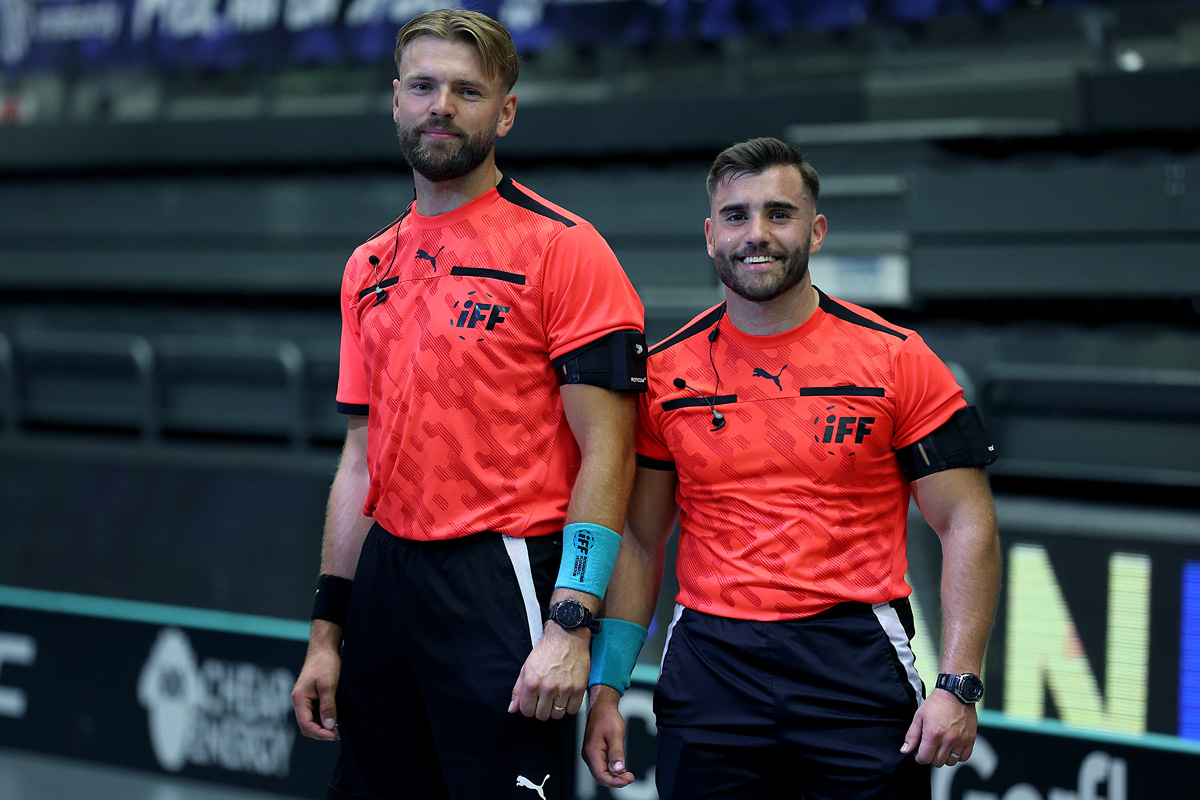
Photo: Per Wiklund (https://www.perwiklund.se/)
Interview with floorball referees Edo Sabanovic and Daniel Hultberg
In this interview, we meet floorball referees Edo Sabanovic and Daniel Hultberg, two referees who have been officiating at the national level for several years. Edo combines his daily life as a preschool teacher with strength training and floorball refereeing. Daniel, who works as an electrician, is also involved as a coach for his son’s floorball team. Together, they form a dynamic referee duo that complements each other both on and off the court. Here, they talk about their journey from club-level referees to national-level officials, the challenges and joys of refereeing floorball, and how they constantly develop in their roles. We at Spintso are especially proud of this referee duo as they use Refcom II during their matches. Read the full interview below.
– Hi guys, who are you?
– Edo: Yup, hi, my name is Edo Sabanovic, I live in Skåne, Skurup, with my wife, I am 29 years old, and besides refereeing floorball, I like to do strength training. On a daily basis, I work as a preschool teacher, and I am in charge of a preschool class with 6-year-olds, which is super fun.
– Isn’t that somewhat similar to being a referee?
– Edo: Yes, it definitely is. Just like the players, they test me, so it’s important to keep them in line, as our coaches in floorball like to say.
– Daniel: Daniel Hultberg here, I’m 31 years old and live in Falkenberg. Besides my role as a referee, I work as an electrician, and I’m a bit of a coach for Vinberg floorball youth, where my son plays. Together with my partner, I have two children. I like hanging out with friends, exercising, crab fishing, and mushroom picking.
– So, you complement each other quite well, with Daniel running the most and Edo lifting heavy?
– Edo: Haha, yeah, that’s right, but actually, we were only 3 seconds apart on the running test.
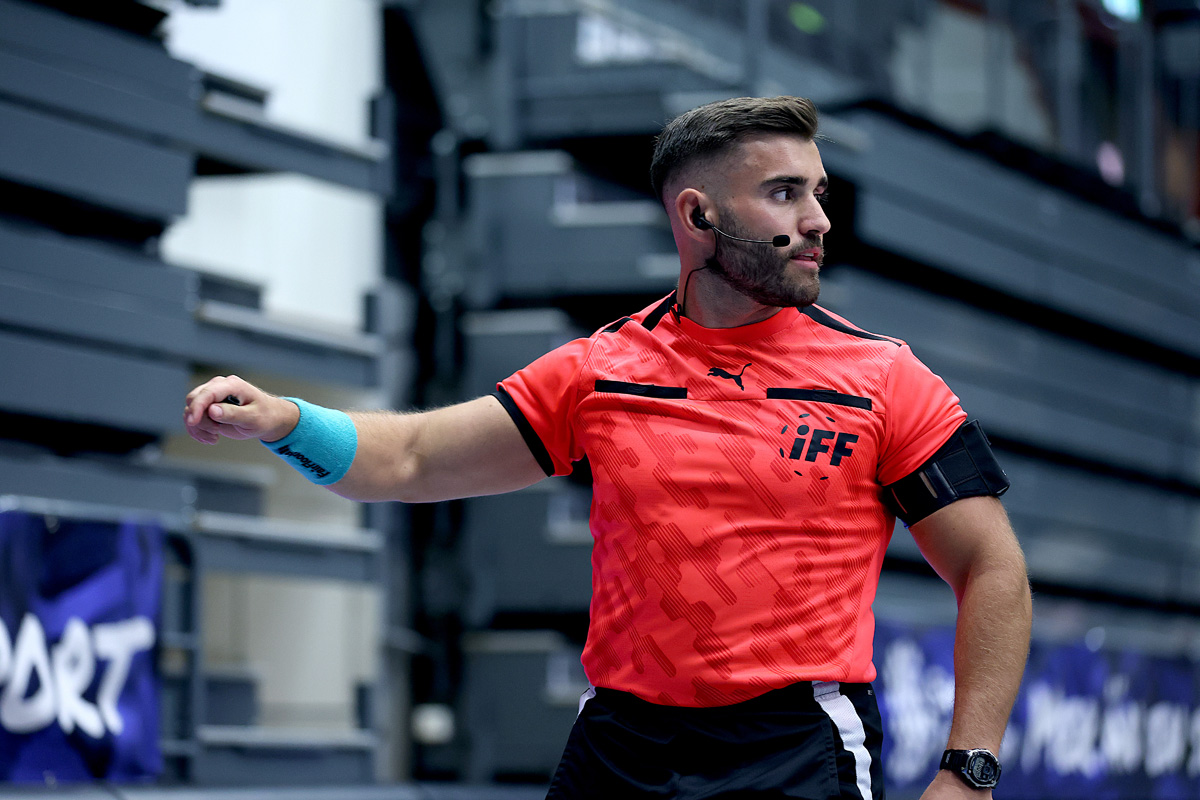
Edo Sabanovic
Photo: Per Wiklund (https://www.perwiklund.se/)
– Daniel, would you like to start by telling us how you started refereeing floorball?
– Daniel: The reason I started refereeing floorball, when I was 12 years old, was because I played myself and then tore my ACL (Anterior cruciate ligament injury). At the same time, I had done some refereeing at the club level and helped my home club, Vinberg. This was when I was quite young, but I got good feedback and response in my referee role. I was told I gave a good impression. I played a few matches, helped to officiate a few matches. It was fun. Then when I got injured, I started thinking more and more about refereeing. I then started taking courses and refereed more and more matches. It grew on me, and that’s how it all started. I have been a national referee for 6 years now, and in the divisions before that, as a senior referee, it was roughly from high school until I was about 25 years old.
– Edo, how about you?
– Edo: I’ve been refereeing floorball for 10 years now, 6 of them at the national level. Daniel and I are somewhat on the same path. I was a goalkeeper before and played for Vislanda IF, outside Växjö. Back then, the dream was to play for Vipers A-team, but that didn’t work out. I tried refereeing at the club and got good feedback from the parents and coaches. So, I simply continued on that path.
– Daniel: I think we both felt that we were helping out at our clubs, and that drew us into the role. We were in middle school and earned a little money for something we enjoyed. When we both also heard that we were doing a good job, we wanted to continue. We simply found a new hobby.
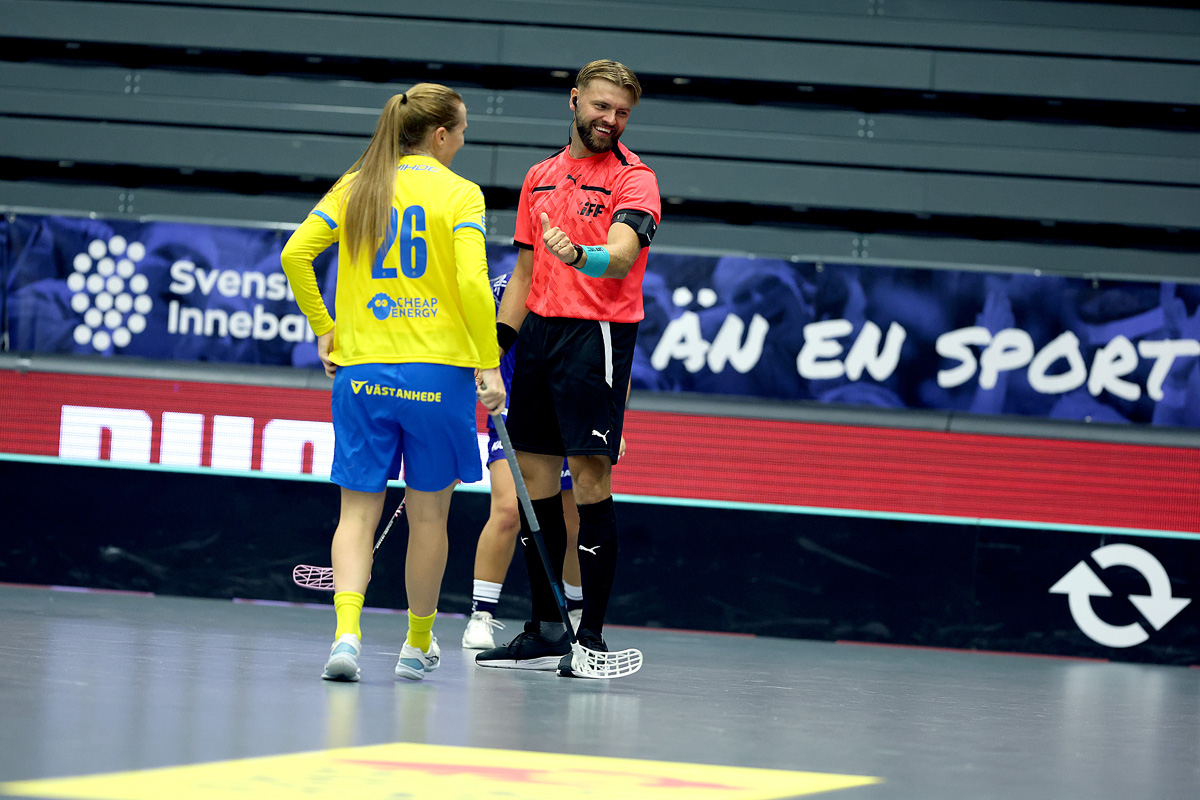
Daniel Hultberg
Photo: Per Wiklund (https://www.perwiklund.se/)
– Floorball, along with a few other sports, stands out because you’re paired up as a referee duo quite early on. Right? How were you matched up?
– Daniel: It was actually Marcus Pettersson. I was close to quitting floorball because I had a colleague where we didn’t really click. That happens sometimes, and I was thinking about quitting. But after that, I met another colleague who was in the same situation as me, but his referee partner was injured. And as a floorball referee, you can have mixed pairs and do substitutions. It felt good then, but he told me before a season that he wouldn’t continue refereeing. That was my third year at the national level, and I was in the same situation again, should I quit now? But then I talked to Marcus at the federation and explained my situation, that I had tried to find a referee partner and that I could use some help. Edo was in the same situation as me, and Marcus paired us up, and now here we are. We clicked right away!
– Edo: Yeah, it was pretty crazy because he really predicted that this would work. That we would get along well. I remember he told me, "Here Edo, here you have a referee who is just as fun as you. You will fit together as referees and do a great job." We tried one match in SSL Women in Varberg, and it worked very well.
– Cool! Apart from running on one referee and muscles on the other referee, and the same humor, how else do you complement each other?
– Edo: As you say, we really have the same type of humor, the same type of jokes. And considering that we spend a few hours in the car together, it's important that we click. We talk about everything, about personal life, about food, and of course a lot of floorball with analyses and game plans. It has to align for us to perform well in a match. If the car ride is stiff, it becomes boring. The trip to the match is at least one-third of this whole referee assignment. Everything has to be right there. We have open communication and tell each other what went well and what didn’t. We have high ambitions, but we have the same goal.
– Daniel: It reflects how it goes during the match, because, as Edo says, it has to align personally. If it does, the match becomes easier, and we can be the best version of ourselves.
– How far is it between Falkenberg and Skurup? Quite a distance, right? Do you often talk to each other between matches?
– Edo: It's about 2 hours by car. We talk a lot during the week on the phone. Same thing there, we don’t just referee floorball, but everything surrounding it is just as much a part of it.
– Do you watch a lot of sports in general, on TV, and observe how other referees act?
– Daniel: I usually watch some football when time allows. When the kids are asleep and I have the energy, I watch some football. I have a new routine now where I train every morning at 04:45 Monday to Thursday, which makes me quite tired in the evenings, so I fall asleep early. But yes, if I watch something, it's football and a bit of ice hockey. But yes, for sure, I watch the referees. I have some contact with a few who referee in the Allsvenskan here in Sweden, and sometimes I ask them for ideas and tips. I watch how they handle different situations and try to apply it in my referee role.
– Edo: I try to watch a bit of handball, football has become less and less for me now, but handball is fun. And as Daniel says, the referee role is similar in many ways, yet different. But there are some tips and tricks you can pick up from other sports.
– Okay, floorball then. What’s the best thing about refereeing floorball compared to other sports?
– Daniel: I think the best thing about floorball is that it's a physical sport, and it's very fast-paced. A match is never decided despite many goals. You can often turn the game around and win, compared to other sports. If it's 3–0 in football, you might feel that the game is more clearly decided. But in floorball, it can be 5–0 going into the third period, and the game can end 5–6 for the other team. I think that’s the art of floorball. Also, floorball is quite strict in a way, with many signals for us as referees. Compared to football, there’s no tactic of wasting time or similar, because in floorball, time stops.
– Edo: Yes, definitely the best thing about floorball is how fast it is! You can’t predict where the ball will go. As a referee, you really have to work hard to try and read the game more. I get a thrill watching floorball, and of course, refereeing. We won’t even talk about the playoffs, it’s so much fun to watch, and it’s such a fast sport. We make judgments all the time and make many decisions during a match. It’s not just about the situations that arise but also about non-situations that involve judgments.
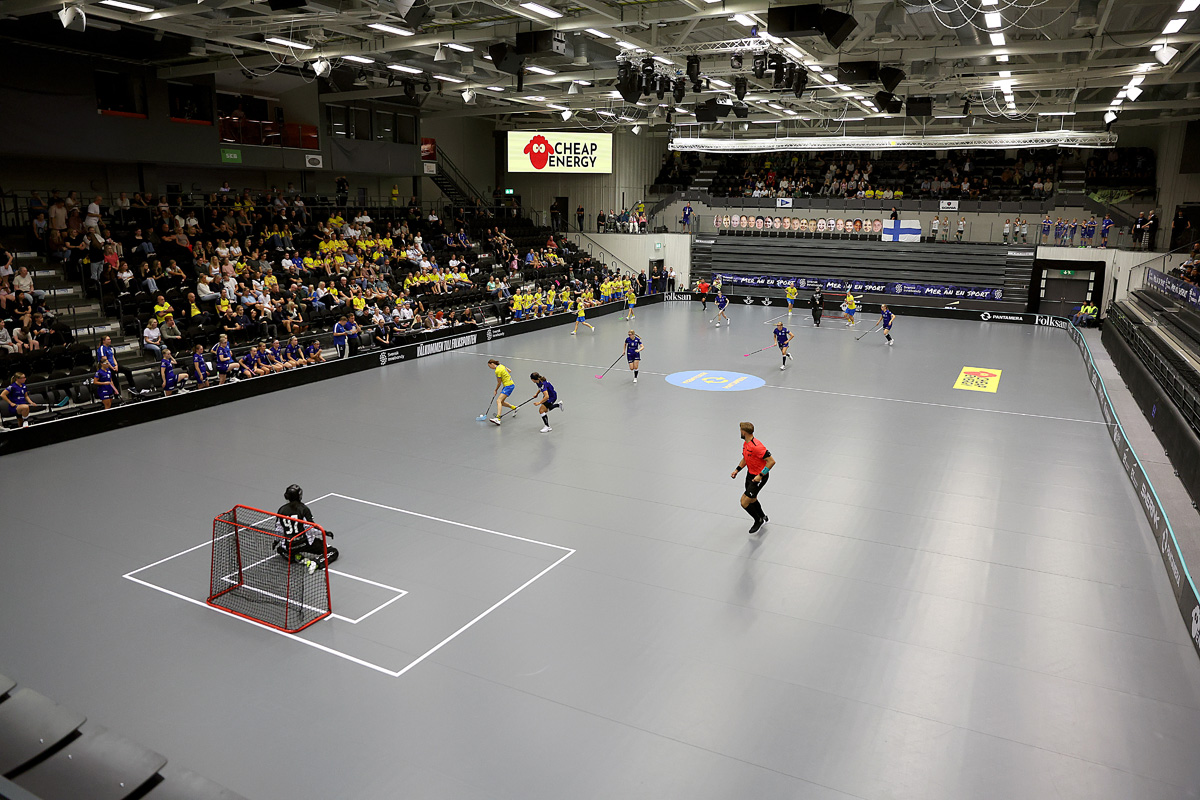
Photo: Per Wiklund (https://www.perwiklund.se/)
– Floorball has always been big in Sweden and the surrounding countries, but it’s growing in other countries, like the USA, which just started a league a few years ago. Why do you think the sport is growing?
– Edo: That’s a tough question, but I think floorball is quite similar to ice hockey. Those who also play ice hockey probably try floorball to a greater extent. In terms of equipment, it’s also a cheap sport to play. You only need a stick and a pair of shoes.
– Daniel: Yes, it’s quite a simple sport that doesn’t require much. Floorball is also not dependent on the weather.
– How have you developed from being new referees, club referees, to now being federation referees? What skills have you developed in your referee role or as a person?
– Edo: Match management. We talk a lot about how you switch roles depending on the match and the situation. You need to be a boss when needed or just go with the flow of the game, or coach the teams as the game progresses. You develop a lot in switching roles there. Then you learn about the teams and coaches, and you adapt yourself a bit as a person in that, to get the best match management possible. The higher you go, the more psychology is involved, I think. You need to handle the players and leaders in the right way, or they’ll exploit it to their advantage.
– There we have the connection to the preschool again, the psychology part.
– Daniel: I also think that as you get older, you take more responsibility for what you do. You build on your self-confidence, and you’ve found your thing, or hobby, that you enjoy, and that’s moving forward. You’re constantly developing, and you grow in it. You reflect on things that are explained to you, ask questions, and get more and more answers to "why." Why should I stand in that position? Then you test it and notice a difference in situations. I think compared to the beginning, you doubt these things and are hesitant to take your place in the same way, but you find confidence.
– Are there things that observers or referee coaches have explained to you that you bring with you to every match? Do you have examples of such things that you often talk about before a match?
– Daniel: The first 10! The first 10 minutes we have to set the tone. We've heard that so often from many coaches and observers. Before, we were sometimes on our heels and maybe adapted to the teams as they started the match. It’s us who should start the match and lead the teams. We’ve started working harder on that and developing it more clearly.
– Edo: We also have to work incredibly hard with non-verbal communication, together with those first 10 minutes, and not just then but throughout the whole match, of course. But body language is particularly important in all referee roles, and it constitutes a lot of our role. When we make a decision, body language accounts for 80% of that decision. Working less with the whistle, showing that you are there on the spot, is enough for the simple decisions and helps us lead the whole match. A simple element, for example, is not using the whistle much but just being present.
– How did it feel when you found out you were going to referee the SSL Women’s final last year?
– Edo: An amazing feeling. We found out via a Teams meeting, where we have a group of referees who had been refereeing the playoffs. It came up there, and we heard, "...we have decided that Edo and Daniel will referee the final," something like that. It was an incredible feeling that’s hard to describe.
– Daniel: Incredible. I remember we entered the meeting, waiting for the answer. It was late in the evening, and I was standing by the kitchen counter, planning to go to bed right after. I stood there with the dishes and just dropped everything… started cheering and got incredibly happy. It was a fantastic feeling!
– Edo: We also had another goal to debut in the SSL Men’s league. It was a similar feeling when you finally hear it and can check off a goal that we had set and then achieved. We refereed Pixbo – Thorengruppen.
– Thanks for this, guys, and good luck in the future!
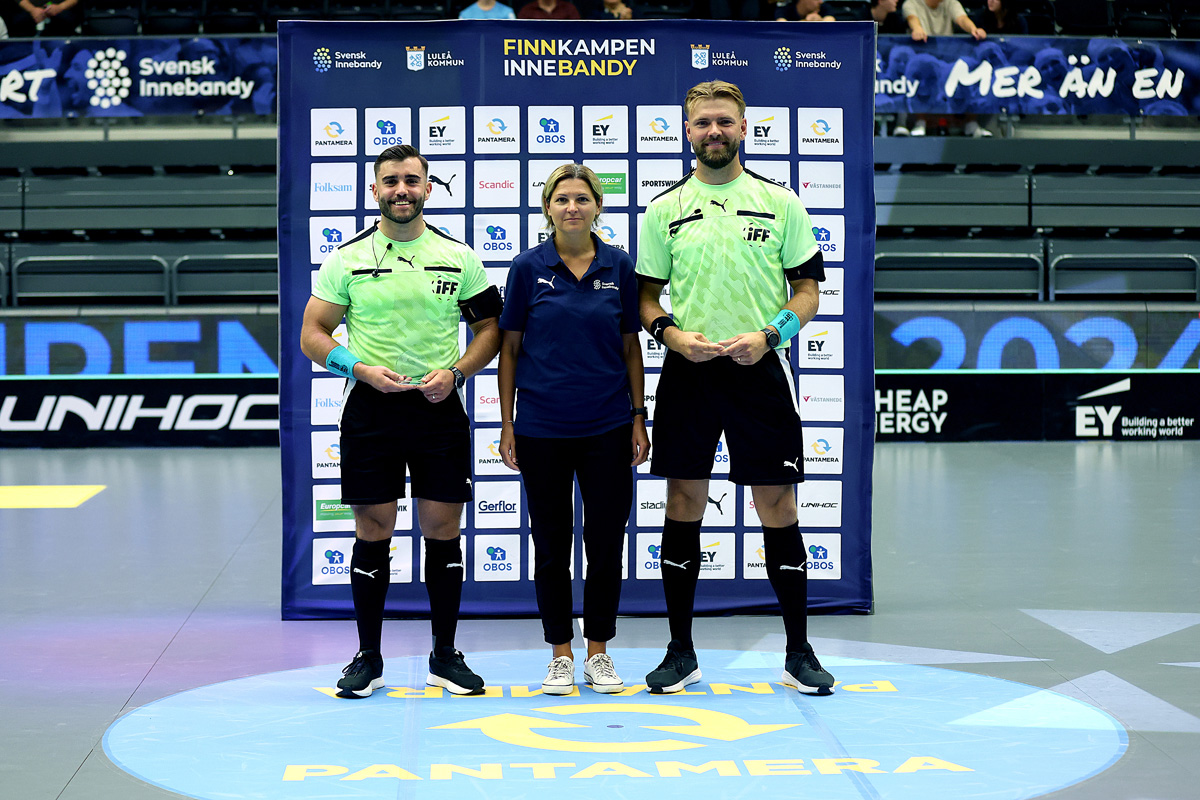
Photo: Per Wiklund (https://www.perwikl