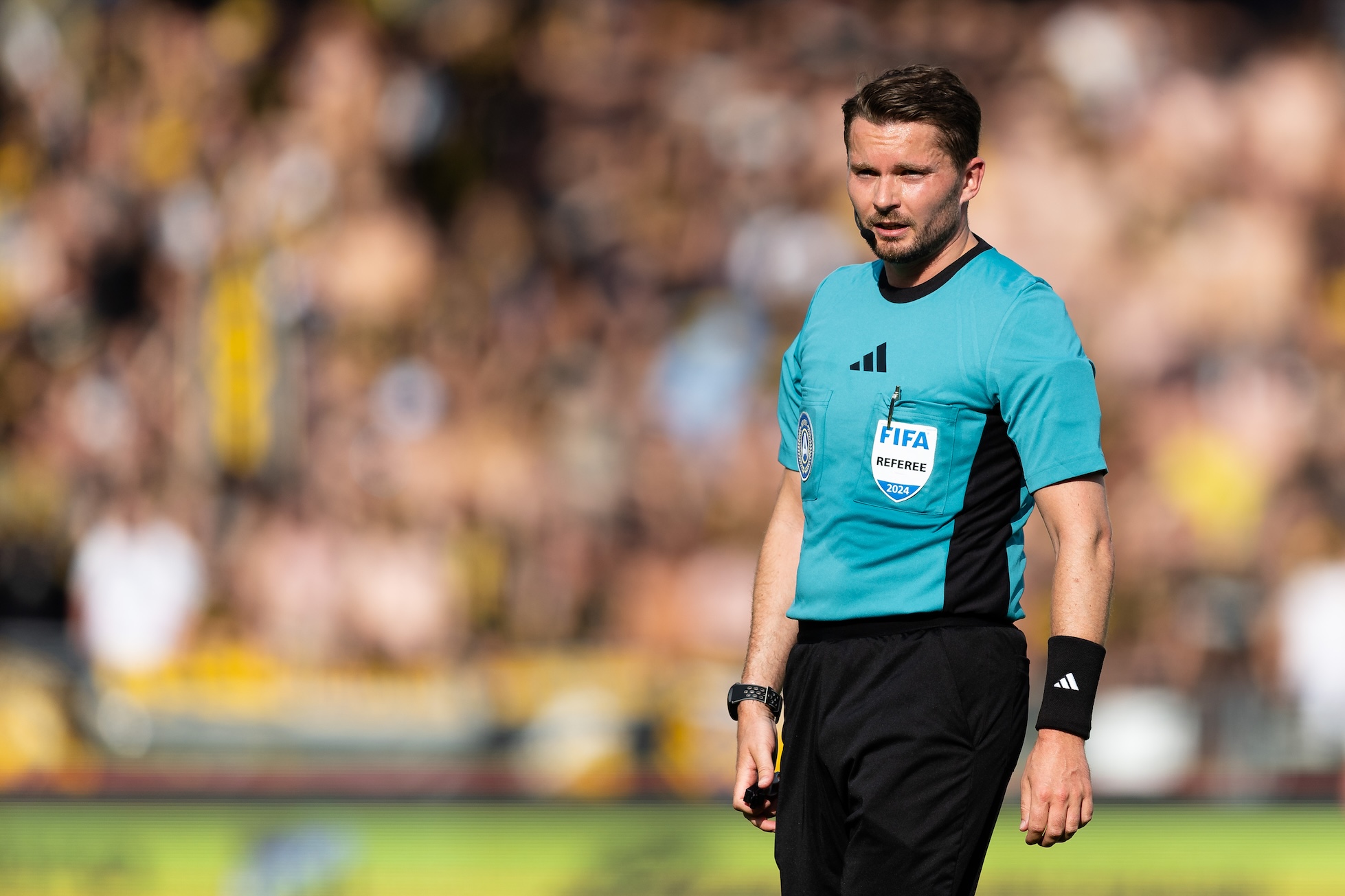
Interview: FIFA Referee Joakim Sars 2025-10-31
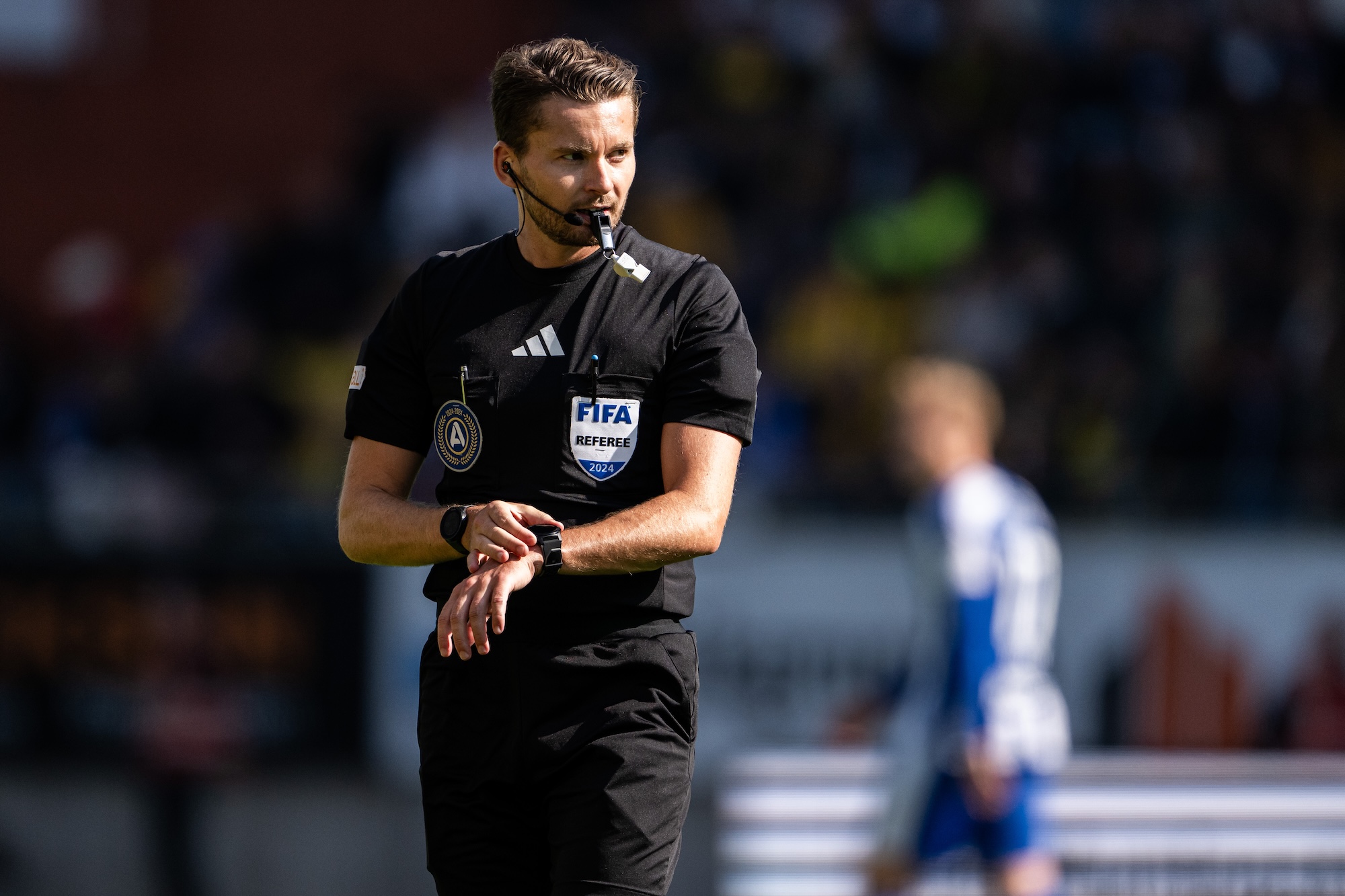
Interview with FIFA Referee Joakim Sars
Being a referee isn’t just about the rules – it’s also about the courage to stand by your decisions and believe in them. In this interview with FIFA referee Joakim Sars (formerly Joakim Östling), we gain an interesting insight into how self-confidence, persistence, and mental strength influence every decision. He explains, among other things, why referees who are unsure often become extra firm – and how you can learn to handle that inner game with yourself. An interview for those who already referee, or are thinking about starting, full of smart reflections, mental tips, and lessons from someone who has made it all the way to the top.
– Hi Joakim, you became a FIFA referee in 2024. Can you tell us about the journey from the lower divisions to becoming a FIFA referee!
– Mm, I started refereeing youth football and my dad was the coach for my younger brother. He took me along to his matches, but I said no, I don’t want to referee. But Dad said, ”Try it!” So I tried and liked it more and more. In the beginning it became a bit of a summer job. Then I completed Step 1 and started refereeing men’s Division 6 and women’s football, and also did some assistant refereeing. At the same time, I played in Division 4. I thought it worked well; it was good extra money and I saw it more as a side job and summer job. Then it went better and better, and as an assistant I moved up a couple of levels relatively quickly. When I had refereed as a head referee in Division 5, the Västmanland Football Association said, ”Now you actually have to choose if you want to referee more and move up, or continue playing.”
– So I stopped playing and chose to climb up to Division 4. After those divisions it went quickly too, to Division 3, to Division 2. Then I was in Division 1 for 3–4 years, I think. When I then moved on to Step 5, I got a ”two” in the group, or that was the grade if you put it that way, so I had to wait a bit and keep refereeing without moving up then. I stayed there for another year or two before I got a trial match in Superettan. In 2019 I moved up as a regular in Superettan. For me it had been unthinkable to get that high. For every division I moved up, I thought a little, ”What am I doing here…”. It kind of flowed along, and above all it has always been so incredibly fun. If it hadn’t been fun, I wouldn’t have continued beyond the regional level. I have put an incredible amount of time and energy into it, and that thing about refereeing a bit as a summer job and the extra money was only when I was young and at the beginning. After that I’ve put in much more time and energy than, for example, I’ve gotten back in money.
— So you were about 25 years old when you refereed in Superettan?
– Yes, roughly. Then during that year I also got a trial match in Allsvenskan and really felt that now things are happening. But then Covid came in 2020 and I had one of my worst seasons ever there in Superettan. I thought it was difficult without spectators; you didn’t get anything for free around you. I fell into a dip in form that I had a hard time getting out of. Ingvarsson took over as our coach and he told me, ”… I know you had a match in Allsvenskan last year, but it’s a new year now and you need to prove again that you should be there.” I didn’t quite do that, I felt. Then the year after, 2021, I got some confidence back and wind in my sails. I got a few trial matches again and then moved up to Allsvenskan after that. But I almost thought I would drop out, or quit after that really bad year. But I got a chance and took it. I was close to becoming a FIFA referee already the first year, but then it took another year. Moving up as an elite referee was unthinkable for me. Imagine then how it felt to become a FIFA referee – completely unthinkable. I thought it was only the very top who become that, like Glenn and Jonas and others. Sometimes when I think about myself, I’m still mentally in Division 1 or something; I need to tell myself that I actually do this full time now and I am a FIFA referee.
– When you have a tough year, like you had then, what made you push on and keep fighting?
– It was probably that I’m stubborn. You probably need to have quite a strong psyche if you’re going to be a referee at all, but especially if you’re going to go far. But mainly I think I got support from outside, from referee friends, privately. I also think the competitor in me told me that if I’m going to quit now, it shouldn’t end this badly. So after a few matches I went extremely much on ”one match at a time and one decision at a time.” We actually had a national team psychologist who talked to us referees, gave a lecture. And talked a lot about what happens during a match. He said, ”Think about one decision at a time, and then think that when you’ve made that decision you should make the next. You shouldn’t wonder whether it was a penalty, or a yellow card. You should never think about the decision you have made; instead think about the next.” I adopted that philosophy a lot – as soon as I’ve made one decision, I make the next, and then I make the next decision… and then the next decision. It took many matches before I got out of the slump, but at the end of the season I stopped pondering during the match about the decisions and got over that dip in form, partly with the help of people around me and this philosophy. Add stubbornness, a bit of competitiveness – it worked for me.
– Interesting! Before moving up to the elite, you choose a path, head referee or assistant. Why did you choose head referee?
– I don’t really feel that I got to choose, in that way. It was more that I refereed as far as I could as a head referee, and chose to do that as far as I possibly could. If I had stayed and been stuck in Division 2 or something, then maybe I would have switched to the assistant role instead. I thought it was fun to be an assistant back then; it probably helped that you refereed one division higher than you did as a head referee. But I enjoyed being an assistant then.
– If we take your role as head referee then. What’s your view of an assistant referee; what good qualities do you think an assistant referee should have?
– This year I’ve been lucky to have Robin Wilde and Simon Kristensson with me a lot. We have worked and talked a lot about this – their view of my role and my view of their role. As a head referee I always want their gut feeling. It can be on the other side of the pitch, or in the penalty area. If they think it’s a caution in a situation, I want them to say it; if their whole gut says caution, I really want to hear it. Then I can use that information to give the caution or not. But I always want to hear their input. The worst thing is when you have a feeling about something, then you sit in the dressing room afterwards and say, ”I thought that, or felt like that,” but I did nothing about it. From everyone in the team I want the gut feeling on situations. I also think an assistant referee should dare to make decisions. Dare to make decisions in front of them, in their area, but also a bit further in if the referee isn’t there. Dare to trust themselves and dare to make mistakes. Sometimes I think there is a big fear of making mistakes. We head referees make mistakes all the time and then we learn from it and move on. We actually talked about this at the last referee meeting – that assistants must have room to make mistakes, because that’s what we learn the most from. I want an assistant referee who is communicative, who trusts their gut feeling and dares to make decisions. If you do that, we become a good team together.
– You mentioned Glenn Nyberg and Jonas Eriksson earlier. Did you have any role model as a referee when you officiated in the lower divisions?
– Well, no, I didn’t really have a role model as such. Of course you watched a lot of Collina and other referees up there, but I never thought that much about it, or about the referee. When I played, I didn’t care much about the referee either. The advantage in, for example, Division 5, when I refereed there, was that you often knew the referees in Division 4 or 3. That wasn’t to my disadvantage; instead you took help from them and adopted things you liked and saw in them. Then as you climbed up there was always someone above me who did it better. I thought even more about it perhaps in Division 2 or 1 – to see how those above me work and act and try to take that with me. Then I’ve tried to copy what others do, and that never goes well. Not for me. You should watch others and be influenced, but you should make it your own thing and dare to try. Dare to try new things, and take with you what works and simply skip what doesn’t.
– How important would you say it is to have self-insight as a referee?
– I do self-analysis every match! I’ve done that for a long time, I would say. I think it followed me from when I played – both how we as a team could have done things differently, but also I as an individual. So I’ve probably done that for a long time. The advantage is when you can get video of the matches, in the higher leagues. Then I realized that I did things you don’t think about. For example, I had a tic of constantly touching the headset. I hadn’t thought about it, but in the film you can see it clearly. Or that you have a certain way of standing when you’re standing still. Things like that – when you see yourself, you reflect on them in a different way. That’s how I became aware of what I do, or did. Also that you think about things, for example at a caution or free kick – how did I experience it live, and how do I experience it now on film. Was it different? Often it is a little different, because the contact may not look as hard on film afterwards. There you try to find that combination between live feeling and video feeling, and that you grow in your decisions based on that. You learn that, and it has to do with routine and experience, and different angles when you see things from other angles. I do that a lot in my self-analysis after matches. Having self-insight is a big part of being a referee and growing more into that role. It’s important, I would say.
– It’s also very important to listen to your coach or observers. Even if everything, or something, they say to you doesn’t suit you or you don’t agree with it. I’ve always thought that I should listen, not object; however, you can discuss the matter and ask follow-up questions like ”what do you mean then?”, but never say ”no thanks, that’s not for me.” That you listen to them, and if they give you three things to work on, maybe I adopt one and test it. During Step 5 I did that a lot – you got lots of new tips and I tried lots of things and some of them worked, others didn’t. It’s important to listen to others, reflect on what they say to you, think for yourself, dare to test it, and try one thing at a time but don’t change too much.
– What would you say is the biggest challenge of being a referee?
– It’s probably that you have to trust yourself. What you see, you have to believe in it. If you’re going to referee a whole match, you have to believe in what you’ve seen until you’re proven wrong. And that can only happen after the match. You have to believe in what you do, all the time. If you have that self-belief in the team that what you’re doing is 100% for us, and you believe in it, then I think you’ll succeed with your matches better. If you start to doubt whether it’s a free kick or whether it’s a caution or not, then I think the level can wobble a bit. Then with experience, you can look at how the players act. At a throw-in for example – who fetches the ball and how the defenders behave. A couple of weekends ago I refereed a match and blew for a corner. Everyone else was heading up for a goal kick; I stood my ground and blew for a corner. Then I felt, ”This isn’t right.” Then you have two choices – either you stand your ground, or you lie down flat. Then you often need help from the team. You can raise your hands and say, ”Well, for me it was a corner but you all say and think it was a goal kick, we’ll go with a goal kick. I apologize.” For 30 seconds someone might think about it, then they’ve forgotten it. As I said, dare to make mistakes.
– How do you want players and coaches to view you as a referee?
– You always want them to think you’re fair, of course. I get it myself, like when I played, that as a player you want everything to go your team’s way and you don’t think about fairness or not. But you still want to be perceived as a fair referee. I also want them to think I’m communicative. I like having a dialogue with players, that I can say, ”I think this because” and dare to say that I might be wrong; then players often lower their guard. Those are probably the two most important things, I think. Then you need to be able to switch between standing your ground or being humble about it. I think that if you’re unsure about your decision, you’re often very firm in a situation. Because then you need to convince yourself and everyone else about it. But if you know you’re right, you often have a bit more confidence and say something like, ”Well, for me it’s a penalty,” calmly and nicely. With penalties in particular, it’s common to also give a caution, just to reinforce that it’s a penalty even more. My biggest challenge as a referee may have been that, now that I think about it – to be calm and pleasant but also able to switch to biting back. And also during a match be able to go back and forth between those two modes. A lot of what happens on a football pitch is a game. The players play a role, the coaches play a role. We referees also play a role. And that role can be that we are kind and receptive or tough and speak up, a bit square sometimes. That in itself is leadership – sensing what role each situation needs.
– Match by match, but is there anything you like to see ahead of you and work towards?
– It’s to be able to take a step up on the international list. This year our goal, mine, Robin’s and Simon’s, was to have a Stockholm derby. We got that and checked it off, which we’re pleased to have had. The next goal is to be able to step up and maybe get a group stage match in the Conference League or something similar. The next interim goal and bigger goal is simply to take one more step internationally. Then we’ll see what happens along the way.
– Do you have anything more to add before we say thank you and goodbye?
– Yes, well, as I said, to emphasize it even more. Which I’ve always believed in myself and which, as a referee, you hear around you from other referees. In different divisions, at all levels, you hear from referees who think and believe that they should be refereeing higher up than they are today. I think a success factor is that you should referee in the division you are in; you should always aim higher, have short- and long-term goals. But you should always referee in the division you are in today. Then you have to rejoice in colleagues’ successes, because then you will get joy back when your successes come. Telling yourself that you should be refereeing higher than you are today is a bit dangerous, because then you are somewhere, mentally, where you shouldn’t be or where you aren’t right now. Land where you are today, but of course want higher. The road there is differently winding, up and down for everyone. My road was also long in the end. But if I can get there, then many others can get there too!
– Thank you for this, Joakim, and good luck!