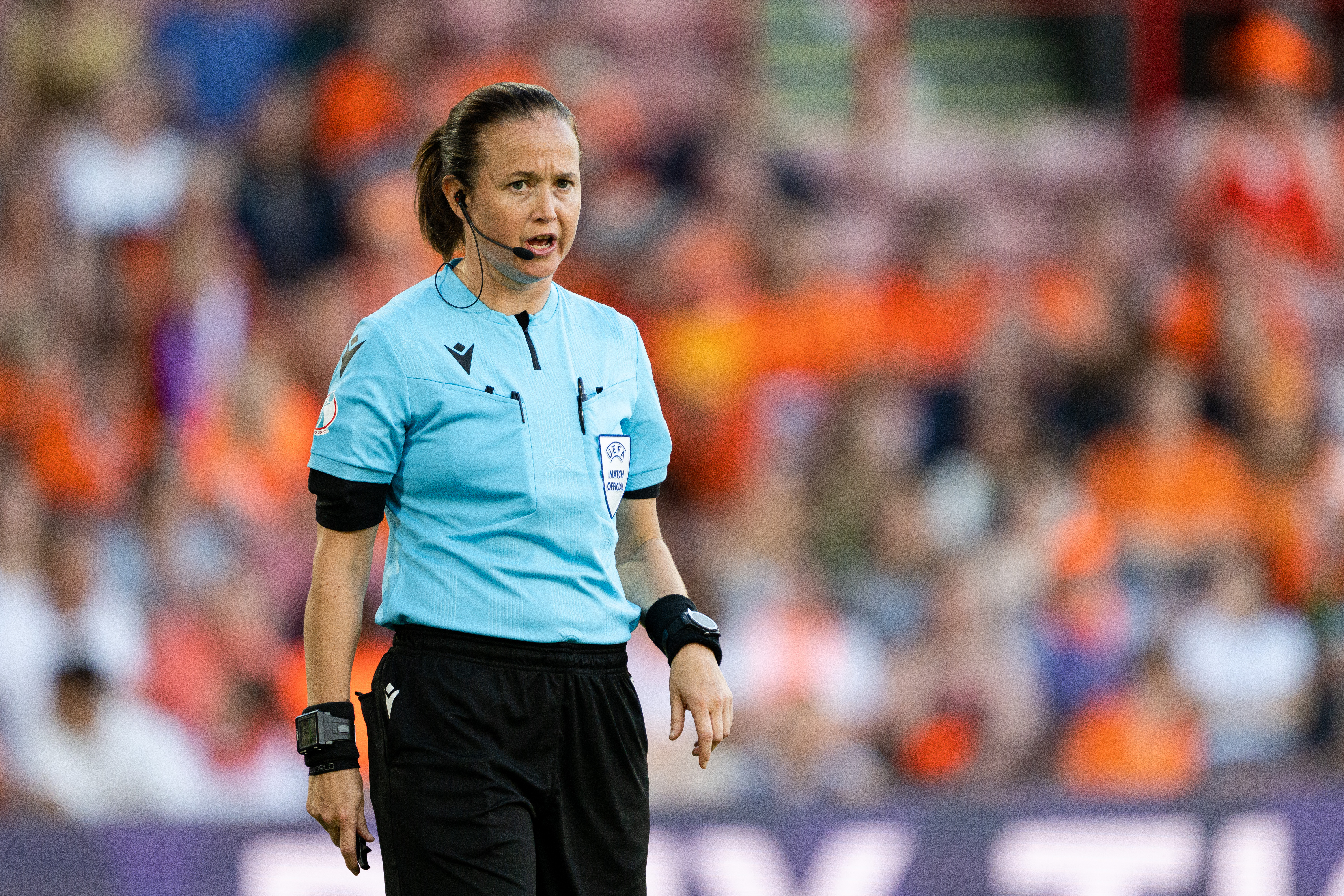
Interview: FIFA referee Cheryl Foster 2022-10-07

Interview with FIFA referee Cheryl Foster
We interviewed ex-football player for Liverpool and the Wales national team Cheryl Foster. Cheryl is now a FIFA referee and has made an exceptional journey as a referee and being an ex-player on a high level. She didn’t gave the referees that much of thoughts when she was playing, but one referee, who is now also her mentor, made an extra impression on Cheryl as an player. She also remembered her first game ever as a referee, as an assistant referee holding the flag in the wrong hand the whole game. Read the full interview below.
– Hi Cheryl. Let's start with asking you, who you are? Who is Cheryl "Fozzy" Foster?
– It's funny really, because when I am a referee I am Cheryl. At work and when I played football they called me "Fozzy". That's all I been called for a long time. In the refereeing world they stuck to my proper name, a bit strange actually. But yeah, Cheryl is a referee and I am also a teacher. When I first got this job I was a footballer and the school has supported me in that and also the transfer for me over to being a referee. The school has been brilliant. I love being a teacher and coming back to work after a referee cup, match or tournament is perfect for me, I love it. It's no different to refereeing really, it's keeping a group of students in check, isn't it?
– Talking about footballer. You have been a footballer, but not just a footballer. You have played for Liverpool and Wales national team for example. And now you are also a FIFA referee. Not many referees can say that they have been both a professional football player and a FIFA referee. Have you brought anything with you from being a player at that level, to now being a referee?
– Yeah, like the most of it I think. I have to learn more about the rules and the laws of the games of course, the laws of the games book is massive, really. Scenarios and situations can change all the time and you have to be there, to really be there as a referee. As a player I only had to worry about scoring goals. My first touch, my passing to my teammates of course, but in the end scoring goals. As a referee you have to work harder. I say to a lot of people that I wish I understood that more, as a player. I probably would have respected the referee a little bit more or appreciated them a little bit more. Then, when I was a player I thought that the referee was there to give me penalties, wave offside and so on. And of course I shouted back at them that I for sure was onside. But one big thing that bring with me, to being a referee, is my football understanding. Football is in my blood and I love the sport. I really believe that football is in my blood. Not just the playing or the refereeing. I watch every game, i enjoy the tactical side, the analyze side of it also. Those things help me being a referee. For example when I am running around as a referee I get inspired by the small changes in formations or any other things, that maybe not everyone see, the tactics around the game. Understanding that gives me a bigger point of view for the hole game.
– When you quitted playing football, was being a referee obvious to you then? Or was there any other option by being a coach or playing at another club?
– I did some coaching courses when I was younger, but when I came to the end of my football career I actually contacted the FAW for two things. One was to see if there was any refreshing courses for me, that I already been taking part of. And the other thing, just for being curious from someone who said to me years ago "why don't you ask about a referee course". And the referee course was first, in the calendar. My contract finished in September and in October I was in the referee course. Technically that course retired me from playing, but I never actually retired as a footballer. The other third option was then maybe to find a new club or play for someone else.
– Interesting. But wasn’t that an option back then? To keep playing?
– For sure, maybe that would have been... but like I said my contract finished. You are always at a point of your career when you thinking if you should carry on. I really never wanted to be that player that played on it's last legs and the club knew it. I loved playing football, so the option was there. But I was somewhere in between decisions and was open into going for coaching for example. The referee course opened up a new door for me, and I liked the course. I told my self back then if I don't enjoy the referee course, then I won't do it. So I did, and I enjoyed it. It also benefit me as a teacher. The more I did it, the more I refereed, the more I liked it. I have the best seat in the house as a referee for watching a game. I'm living through football and in that world, the football family, I have the best job. The best view, I see every tackle, header, goal and pass with the best view of them all.
– You said you wished you understood what it takes to be a referee when you played football. But was there any specific referee that made impression on you as a player? A referee you looked up to?
– Yeah! When I was playing for Wales in Switzerland we had a counselor that comes with us. This counselor that joined the Wales national team back then was Cliff Evans who was a former referee also. He sat down with us the whole team at a long table, and he said "anyone of you fancy refereeing?". And we all laughed, including me. That's like ten years plus years now, but something stayed with me towards the end of my career as a player. But if you asking me what referee that sticks out I know one. I am also very, very fortunate that she is also my World Cup mentor. The was for sure my favorite referee when I played for Wales and that is Jenny Palmqvist from Sweden. The reason why I liked her is that she smiled and she talked to you. I remember her personality and I remember me to have fully respect for her. Because of all the attributes she showed on an international stage. I went to a course a few years ago and she was there. I was thinking about telling her, you know. And I did. I got over to her and said "You are my favorite referee". And she took it very well and now I am grateful that she is my mentor, and the last year she has helped me a lot with getting a different level of understanding. If she sees this or read this, i probably would think it's a bit cringe for me but she is really an excellent mentor.
– Can you take us from Cheryl as a new referee to where we are now? A sort of timeline maybe.
– I actually started as an assistant referee, that was my first game. I had the flag in wrong hand and i was like three foot away from the line. It was about learning quickly. I absorbed a lot during games and courses. I progressed through the levels and got nominated for the FIFA badge is 2016. Which is quick, because I started in 2013. I think in the beginning was that I was a former player as a high level, and the observers could see that. The biggest thing and change from "Fozzy" as a player to Cheryl as a referee, and the person that I am now i think is that i learned a lot. I am still learning better positions and I am still making wrong decisions as a referee, we all do. I do thing out of instinct. I have learned a lot and still absorb situations. As a referee you see new situations all the time, maybe a situation happen once and then you never see it again, never ever. I have developed my teaching skills both as a referee and a teacher. Dealing with people is a huge thing and I have grown with that also.
– Three or like four years of becoming a FIFA referee. That has to be some kind of world record?
– Yes... maybe. I use to say that the ones that I met in different tournaments and so on, you know when you asked them what's your name, how old are you, how long have you been a referee and so on. The girls around me use to say that they have been refereeing for 10 or 15 years, and been a FIFA referee for a lot of years. And I say, yeah, I started refereeing just a few years ago and now I am a FIFA referee. Some for sure thinks that is to quick, you know. And I respect that, that opinion is ok to think. Because on paper that is quick. But then other people also say all my years as a player, could also be counted in there in some way. That has of course helped me in my career, but I am here because I love football. I can deny that is was quick, but I have also taking all the opportunities that has been given to me.
– What's the best thing you can send to a referee, at any level, to improve their refereeing skills?
– You got to earn your respect. You got to be fit, you have to be in the right positions or at least you have to be in the right position where the players can have some respect when you are making a decision. Does that makes sense? Even if it's the wrong decision... if a player turn around and look for the referee, and the referee is next to them, in a way - How can then question your decision then? How can they not respect you then? You sprinted the hole length of the pitch to be there. That's one way to earn your respect. I think for me one of the things that makes a good referee is communication skills, with that said you don't have to be a chatter-box or you have to speak to every player, because you have a job to do. Having a good personality as a referee is important, if you don't you have to work and improve those skills, to be human, to be able to listen and also give the players respect. As O talked about Jenny before, she could smile but she could also tell you off without shouting or being silly against you as a player. The reason a player is frustrated is maybe not that you given a decision against them, it could also be because that player missed an open goal two minutes earlier. It is a level of frustration and emotions the hole game. Communication skills with players, coaches and your referee colleagues is key, you have to be able to handle those emotions, different emotions, with players. You can for sure have some kind of dialogue so they maybe understand at least something.
– How can the football clubs help with this thing, helping the players to handle their emotions?
– When I was playing I said after that I really wished that I had a better understanding what it is to be a referee. When you are being sent off in a club, at any level, you maybe have a fine. Rather than fining the players from the club, maybe the club gives that players a Under 12 game to referee. Let them see how it is to be shouted at by players, coaches and parents. Then they maybe are saying "oh, actually this is pretty hard" or something maybe can help them open their eyes for the refereeing role. That can make us give the players better understanding and maybe even give us more referees if someone really, like me, really enjoys it.
– What's the most proud moment for you as a referee Cheryl?
– Do you have any goals further ahead that you are working towards?
– I think a few years ago I was looking at those tournaments, you know Champions League and the Euro's and so on. But looking at my age and so on we have to work forward. I would enjoy going into the later stages again in Champions League of course. But I would be stupid not to say that the Women World Cup in Australia next year is not a goal, so that is something I am working towards. But that is a goal for 50-60 or even more referees around in the world, so I can just do my best and hope for the best there. I saw a snippet of that in Costa Rica when I was refereeing U20 World Cup, this year. That made me want the senior World Cup even more, because it was so much fun, what an experience.
– Cheryl, many, many thanks for your time. We are looking forward to follow you on your journey as a referee.