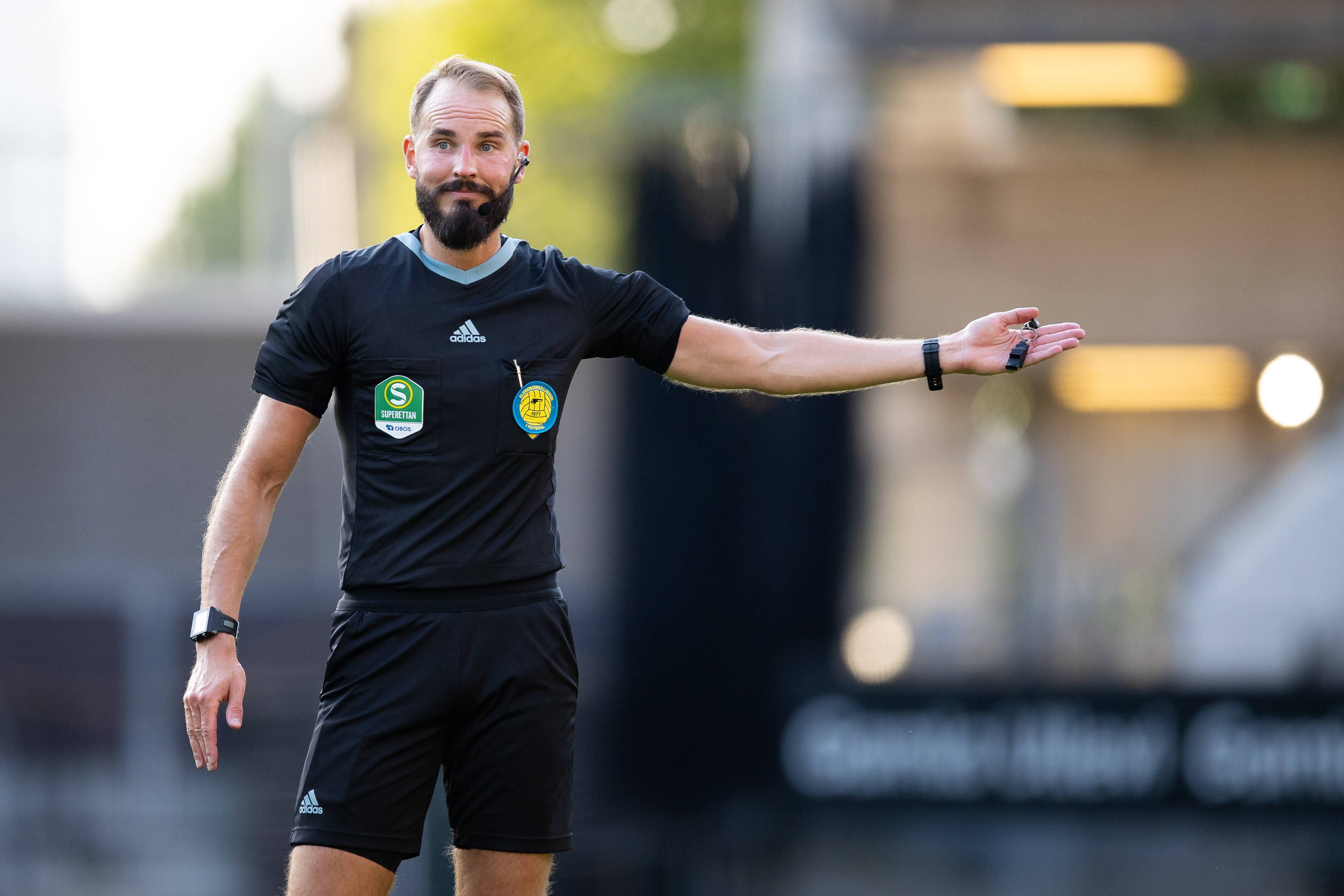
Interview: Andreas Dufva-Johansson Elite Referee Football 2024-01-08
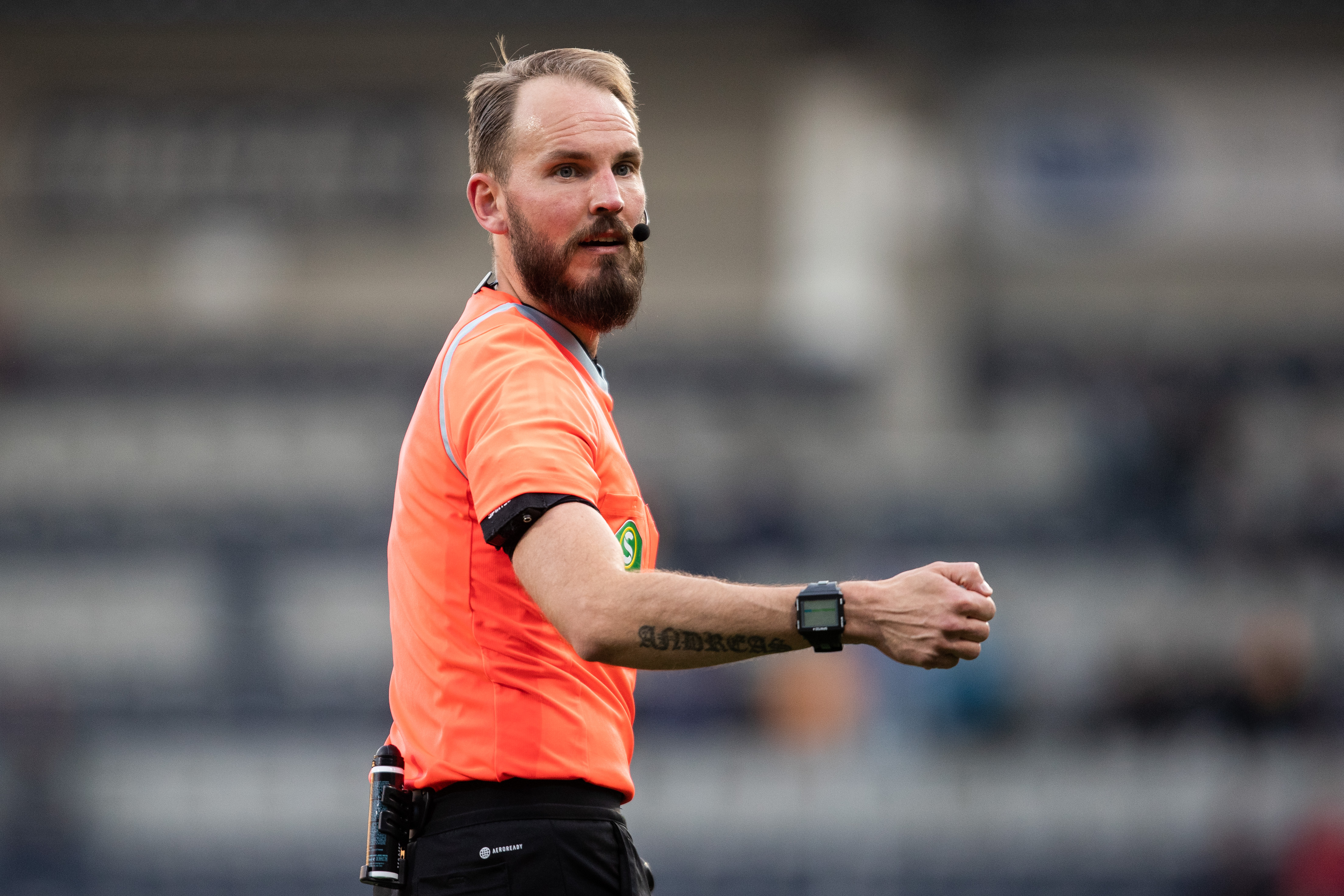
Interview with Andreas Dufva-Johansson
We wanted to talk more with Andreas Dufva-Johansson because he referees with both a Spintso watch and a Spintso headset. Andreas started refereeing early, at the age of 14, where the interest in the referee role grew and flourished. Today, 20 years later, he is one of the most experienced referees in Superettan, next highest league in Sweden. Andreas can feel the experience gives him a secure and stable ground to stand on. Read his thoughts on the referee role and the importance of leadership below.
– Hello Andreas. The 2023 season ended a while ago, and we are entering a new year and soon a new season. How do you feel looking back on the 2023 season?
– Very good. Some seasons you can feel more satisfied with than others, and other seasons may have felt a bit challenging or things went against you. In recent years, I have felt very stable. The mindset is to take one match at a time, go there and say "I'm going to do my best." I hope all referees do that at every level for every match. It doesn't matter if it's round 2 or round 30; all matches are important. For us elite referees, it's extra important because there is economics involved, contracts, and agreements. You feel it on the field as an elite referee, and every decision is crucial. You go there prepared. Summing up my season, it feels stable and secure; I have also been in Superettan for quite a few years now. I have gotten to know many coaches, players, and organizations, which also adds to it. It builds on trust, and I have built it up with many teams, which in many cases can make the journey a bit more harmonious, of course. Of course, there are a couple of decisions that haven't been right, that's always the case. I should have trusted my gut feeling there, but overall, they are not major issues, and I am satisfied with the season.
– Wonderful! Now you've had some time off, but how does that feel? Are you eager to start the 2024 season already?
– Now, having a family with children, it's a bit different with a few more weekends off during the winter. Which is both important and fun! Nevertheless, it's training for me. Training for me is a lifestyle and is always ongoing, and I train and put pressure on myself. In a way, it feels like the season never ends, so to speak. You always have to keep your body in shape for refereeing but also for health and the rest of life. It's definitely possible to relax a bit now when you're off, and you don't have two days away or any longer trips. Then the break goes by very quickly. We had a closing event towards the end of the year, then it's Christmas, and then it's time. But yes... it's a bit nice to focus on two things instead of three, for a short time at least.
– You've been in Superettan for a couple of years now. But how long have you been refereeing football in total?
– Oh. It's been a long time. I started refereeing when I was 14 years old. I started as a club referee, and that's where the whole interest in this began. I refereed while I played as long as I could before I chose a side. So, I have refereed football from the age of 14 to 34, which is my current age... that's 20 years.
– 14 years old, and that's where the interest began. But why did you start refereeing?
– We received a request in my club where I played, Huskvarna FF, if anyone was interested in taking the course to become a club referee. The question came to us, where you could also start earning some money from it. You were 14 years old, and a little extra income is never wrong at that age. That's where the interest was born, and you got matches, showed commitment, found it fun, and earned a little money for it. Then it progressed, and you refereed more, gained more understanding of leadership, and grew into the role. Something bigger started growing in me, and I liked it.
– Would you say that you have benefited from the referee role in other aspects of life?
– Oh yes, in everything, I would say. As a referee, you are put in sharp situations; it has to be quick, you have to be confident, stable, able to communicate, focused, able to handle people, and so on. If you were to summarize what is required for a referee, it's more or less the perfect person. It has given me a lot back in my other life, especially in the professional world, and that's why I have gotten some of the positions I have. You look at things completely differently. You handle situations that arise in a completely different way and with calmness. Conflicts and similar things. Simpler things in both private and professional life become easier to handle, I think, compared to the work environment as a referee. If you become or are a referee, you get the world's best leadership training.
– We touched on training a bit, but what does a typical preseason week look like for Andreas?
– I'm a training enthusiast, haha. It runs in the family. I go until I almost collapse, more or less. But it varies what I focus on. I've always been a master at running and have good endurance, and I like to challenge myself there as well. A typical week, I would say, consists of the heavier sessions at the beginning of the week. Mondays involve some form of interval training, outdoors or indoors. Then I always combine it with some strength training for the whole body. I always finish these sessions with basic exercises. Mondays might be intervals without incline, and then on Tuesdays, it's intervals on an incline. Wednesdays, I usually take a break, eat well, and enjoy being at home. On Thursdays, I might go for some tabata or grit sessions. They are so good because I often work on muscle groups that I'm not used to. On Fridays, it's stretching and more focus on injury prevention, but I can also combine this with a core session. Then on Saturday and Sunday, depending on the week, I might settle for a long walk or, alternatively, run a bit in the forest. I really love running in the forest, and it could be either 5 km or 10 km. Not competing with the clock, just enjoying the environment a bit. So, that's how the week goes, I would say.
– If you had to choose one thing that is the best about officiating, what would you choose?
– One word that sums up what I stand for is what we touched on a bit earlier, and that is leadership. Having the opportunity to lead this big thing and shoulder the responsibility for an entire match, that is leadership. Out of that comes fairness and earning respect. I love football so much, and it must be as fair as it can be. Players should get what they deserve, fair decisions, and it requires effort to make it as good as possible. But definitely, I choose leadership as what I consider the best thing about officiating in football.
– How do you learn leadership then? Or how can you develop it even more?
– First and foremost, you must be able to be humble. That's a significant factor. Then you have to add other things to it, such as experience. You have to make mistakes, make many correct decisions, and get feedback about it – you need to fill your backpack with all these things. And then you have to officiate more matches, and even more matches. In humility, important details are included, such as the willingness to listen, the desire to learn and develop, and understand the feedback you hear or get from colleagues or observers. It's humble and hopefully, there are people there watching you and giving you feedback who want the best for you. What are they saying then? Have they noticed a trend in things you always do? Then you must be humble enough to take it in and dare to try it in the next match. Dare to listen and watch a lot of football, both live and on TV. That way, you will subconsciously get better and strengthen your leadership. You create good conditions for leadership by listening, being in good physical shape, having good rule knowledge – here, leadership is born.
– Do you have any tips or tricks for referees out there, perhaps leadership tips, in a match situation?
– I can share two. I have been in situations where players have been generally upset with me as a referee, and I have lowered myself to their level, responding in kind. It never turns out right. You must understand that I am the leader, and we must maintain some form of security. But that wasn't the example I was thinking of; another example is that I have sometimes made the wrong decisions when I haven't followed my initial feeling and hesitated a bit. Maybe, in consultation with my assistant referee, we make a joint decision that turns out well or poorly there and then. But afterwards, I might see that my initial feeling was 110% correct. The role distribution we have, in broad terms, is that an assistant referee is an expert on offside but can also be an expert on other decisions, while I, as the main referee, should be an expert on more or less everything else. My judgment on a situation may be a caution, but a colleague referee's judgment might be no caution or even a red card. Here, of course, you should work together as a team and be collegial, but what I'm after is that your initial feeling is often very correct. Don't hesitate, be firm, and take what you think. You develop that as well, where even an assistant referee learns to develop their motivation, such as for a red card with words like "the leg is straight, high up, a risk of injury, violent, and uncontrolled," and so on.
– Another example of leadership tips is communication. I am very communicative. I am tall, communicative, and work with my whole body, taking advantage of that. I think communication is the most important key in leadership. You shouldn't go around talking to everyone, but as soon as you see something that needs attention, take the time to address it. An example is that we referees often talk about these players who are a bit grumpy or who often complain about us referees or try to divert the match in a direction other than what we want. It's important to identify this early and address it. Call such a player over and preferably use their name if you know it. Then you might say, "I understand you, but today I want us to have this level, and we can talk. I'll do my best, and I can make mistakes." You have to try to get the players on board with your thinking about where you want the match to go. Be willing to expose yourself and even say that we make mistakes, that's just how it is. I apply this very often.
– What are you looking forward to in the 2024 season?
– It's always special when you enter a new year. There's always excitement, and I get motivated for the training sessions every year. I know there will be things we need to focus a lot on during the year, and it's really as they say: New year and new opportunities. I'm very excited to take my areas of development from the previous year and work on them. The feeling of starting anew and doing it better is wonderful. I also like that we all have a unified view on, for example, inappropriate behavior, that we all try to follow the same line. Here, we usually work on focus areas for the referees, both at the elite level and further down in the systems. That Swedish football and Swedish referees stand behind this, and we follow it. Applying justice and being tougher on inappropriate behavior.
– What were the focus areas for 2023, how did they look?
– We talked a lot about inappropriate behavior, definitely. But there was more focus on match-deciding decisions. That is, situations in the penalty area and judgments for red cards, finding correct judgments there and activity in areas where such things can happen. Another thing for us was preparation and pre-match. How do we prepare before the match, and what do we need to practice more and what should we go through during the match analysis? We had more focus areas, but those were some of them.
– If you get to think out loud, what do you think should be a focus area for 2024?
– There can be a lot of complaints and whining, players surrounding the referee after decisions. Here, we, but especially from higher up, must put our foot down a bit. That it now becomes even easier to get cautions for such behavior. That we make a strong stand against it. You can think and express yourself, to a certain extent. Europe has started with it, slowly but surely, and I'm sure we will continue to have it as a focus area. But if I think a bit more personally and get to think a bit, I wish that what we rarely can get to and find difficult to deal with right now. That goalkeepers lie down and pretend to be injured to delay time. Leading a team 1-0, and then the goalkeeper lies down, the treatment takes 3-4 minutes, and then maybe he lies down again. We can't get to it. Who am I as a referee to say if he or she is injured or not and needs treatment? We can't handle it completely now. I'm not a doctor. A difficult moment to enter. Here, maybe we can get more tools to use, such as if you lie down repeatedly, it will be equal to 5 minutes of extra time or something else. To start eliminating it. It shouldn't be rewarding to lie down, simply. How do we regulate it in the rulebook? Very difficult, but it's one thing I wish we could start addressing.
– Thank you for this, Andreas, and for sharing your reflections. Good luck with the 2024 season!