
Interview: Ademir Avdic FIFA Futsal-referee 2022-09-20
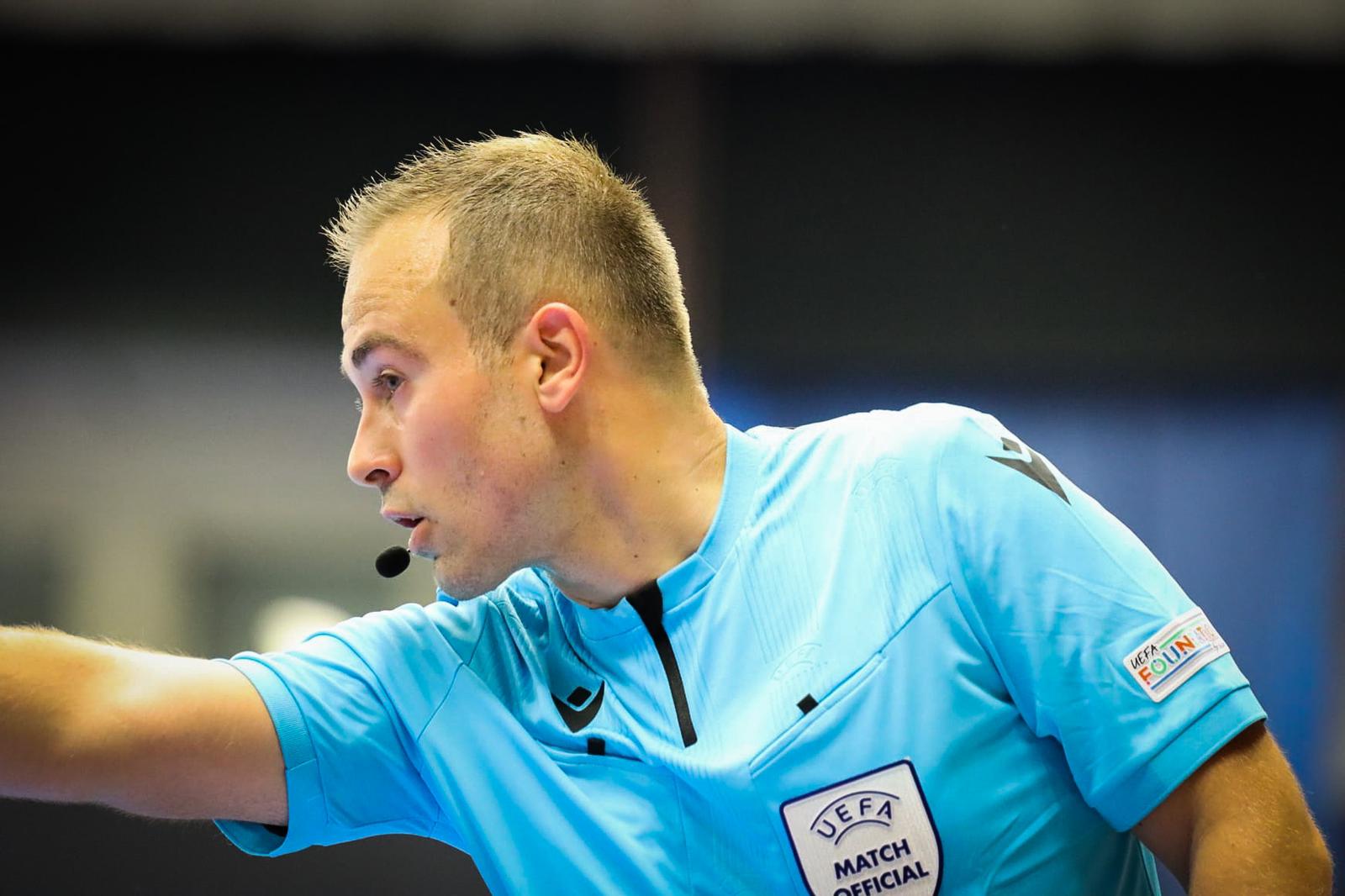
Interview with FIFA Futsal referee Ademir Avdic
Ademir Avdic is one of the Swedish referees who is a FIFA referee in Futsal. Ademir referees the highest league in Sweden, the Swedish Futsal League, or SFL. This weekend, Ademir also refereed the Nordic Cup, which is a prestigious mini-tournament between Sweden, Norway, Denmark and Germany. Normally Finland is included, but this time they chose not to participate and then Germany was invited instead. Now that the Futsal season is approaching in Sweden, we thought Spintso would have a longer talk with Ademir about Futsal and the synergistic effects between that sport and others.
– Hello Ademir. Nordic Cup, can you tell us more about it?
– Hello! And yes, the Nordic Cup was played in Norway this time. This year it was a slightly different edition with Norway, Sweden, Denmark plus Germany. Finland was not there this time and is instead playing another tournament in Asia. The tournament is prestigious and there will be many derbies and heated meetings. Educational and interesting in many ways for us referees! The tournament has been around for maybe 7-8 years and there are elite referees from the participating countries. Then there may be a few more referees from the nation where it's being played. Super fun for us referees with new acquaintances and useful to meet others, and then referee together with others with whom you are not as comfortable as usual.
– Cool. But Ademir Avdic as a Futsal referee, how did that journey begin?
– I started refereeing football, outdoors, as a 16 or 17 year old. There were then indoor cups and then you played Five-a-side, in the good old days when there was a lot of harder tackles in the matches. I refereed indoors for a couple of years and then it switched to Futsal and I joined that train. I got more and more hooked on it. From the beginning, there was a break in the winter, when there wasn't much football and I wanted to fill that time with more football. I still referee football, in Division 3 as the referee in the middle and Division 1 as an assistant. Football is a good supplement for me to keep going, and that football and futsal have many good synergistic effects. The sports are very similar and you get to practice a lot of match leadership in both.
– Exactly what you are saying now, many referees are saying who referee or have refereed both football and futsal. What are the similarities and what kind of things do you benefit from, in both sports?
– As far as the role of the referee is concerned, a lot is about teamwork and cooperation between the referees, in both sports. In futsal, that cooperation is needed, but in a different way. It is more intense and a closer collaboration is required due to the fact that there are two referees. The roles differ more, more clearly in football. You get a lot back through both sports and above all you get to practice the most important things of being a referee, match management, but then also this with the cooperation which is so incredibly important. I have also encountered some floorball referees where close cooperation is also required and we have not yet entered into deeper discussions with them, but it would certainly have been interesting going forward and exchange experience with other sports referees.
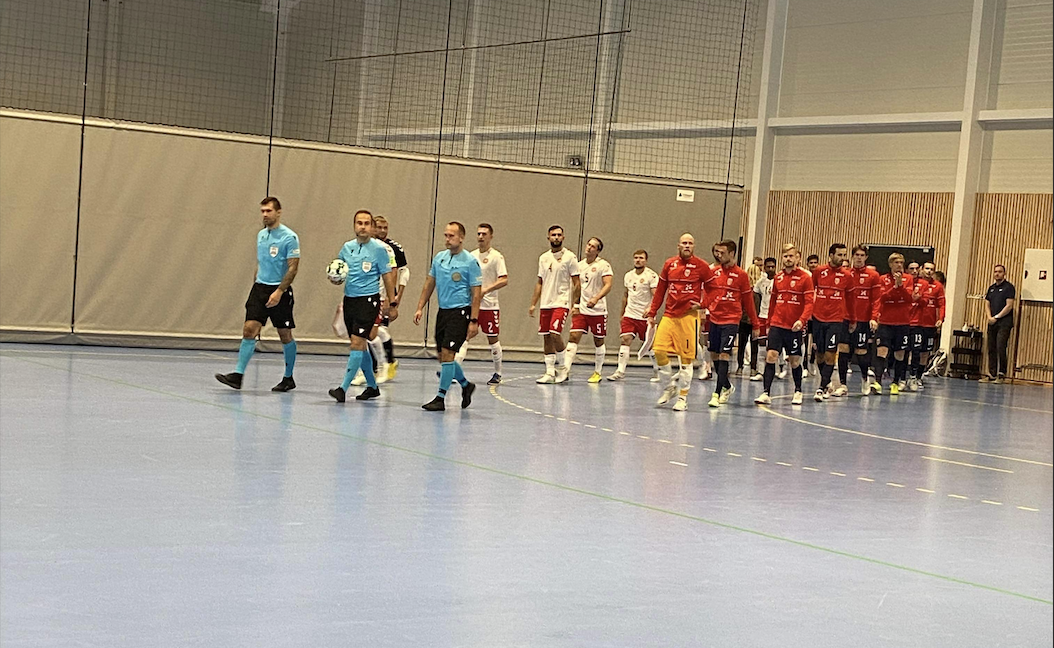
– Isn't the most difficult thing in futsal that everything goes so fast? Correct me if I'm wrong.
– That's absolutely right, the biggest challenge is the intensity. It's also the thing that i'd like the most as a referee and a big reason why I like it so much. Stuff happens all the time, constantly, during the matches. For example, you can compare how much the ball is in the penalty area in soccer versus futsal, where the toughest decisions have to be made. There are more sensitive situations in futsal and every direct free kick is accumulated as well, where every free kick matters. There is also a big difference between the sports but also a fun challenge that exists in refereeing futsal. It is clearly more challenging. All decisions are of great importance for both teams, in futsal. In soccer, a free kick far down in the opponent's half is not at all sensitive or difficult to take, in futsal all decisions are sensitive. A ball that's passed the sideline in futsal, a little higher up the pitch can in itself be a scoring chance. All decisions, even the small ones, are important and can decide matches.
– What does it take to be a futsal referee?
– Above all, it is knowledge of the rules. It provides security in decisions you make and why you do this or that. If you have a good knowledge of the rules, it usually turns out to be right and good in the situation you find yourself in then and there. Of course, if you look at replays and other things, you can definitely see something else then. But what I mean is that if you are confident in the rules, it usually turns out to be the most right. Then there is also being able to collaborate with people. Not only with colleagues and referees, but with the teams, officials, players and so on. You have to be able to handle people in a good way. I think those two qualities are important to have with you if you referee futsal. Then, in order to referee futsal, you must, just like in soccer, pass a rules test and a running test. The running test is more intervals or short intervals, compared to football.
–Knowledge of rules... can you tell me about a rule in futsal that not many people know about.
– Hmmm. What was a little problematic for us referees in futsal was the change if a handball leads directly into the goal. In football, an "involuntary" hand in direct connection to a goal is decided as not a goal and a direct free kick. Futsal had a problem, which has been changed this year, however, with just such an involuntary hand where it is not at all intended to bring the hand and the ball goes into the goal in direct connection with it. If there is a handball and a direct free kick, it could result in a direct free kick from the 10 meter penalty spot to the other team. For something that you weren't looking for at all, i.e. an involuntary hand. It's a pretty heavy punishment to receive, when you weren't even close to that intention. Now it is therefore changed to an indirect free kick, when it has thus been an involuntary hand. In other words, it will not be an accumulated violation or free-kick. If you take more than five direct free kicks against yourself, in futsal, the opposing team gets a direct free kick from the 10 meter penalty spot, just to make that clear as well. We therefore do not count this involuntary hand in the direct free kicks anymore. If, for example, you get a ball in your hand and it goes directly into the goal, then it is not a goal and an indirect free kick is awarded to the other team.
– We at Spintso have received thoughts about what type of shoes indoor referees use and what type of whistle. What do you use?
– Shoes we usually say black, preferably completely black shoes and "regular" indoor shoes. Adidas have been popular, for sure. There it is so individual, but black shoes to get uniformity as a referee. It's not a rule, but most referees tend to go by it. Whistles are also a bit mixed and individual. I use Molten which is quite strong, for being indoors. Indoors and in futsal, we rarely want weak signals, especially during the course of the match. We don't have "easy" free kicks, but when it's a free kick, it must be heard. As a signal, there is very little variation in our free kicks, if we again compare with outdoor football where you send more messages with the whistle. Some referees also use the Fox 40, it is pretty popular.
– The popularity has definitely increased for the sport of futsal. How do you referees notice that?
– There are many more TV matches and everything around it that we have to take into account. It changes the layout before the match, sometimes after but also during the match where replays and other things that have to be taken into account. Then I think that interest, as you say, has increased and there are more and more audiences at the matches. It increases the pressure on the matches and the emotions all around. We also get international players into the Swedish league, where teams sign more players here. The quality of futsal is getting better and sharper. It is clearly someone we referees notice!
- Last question Ademir. You judge outdoors in the summer and indoors in the winter, a little simply explained. What do you do more than judge?
- Two small children. That's good enough! Not much more can fit into 24 hours than the children, exercise, friends and family. Then I want to add again that futsal and soccer have a lot in common, so my recommendation is to try futsal if you are a soccer referee today. You get a lot in return regarding match management, community, cooperation and more. It's a good school. Then there is a big risk that you will really like it, and you will get stuck there, like I did.
– Thanks for this Ademir. It will be nice to watch some more futsal soon! Good luck.
