Ted blog post: What exactly is an "advantage" in football? 2022-01-18
What exactly is an "advantage" in football?
Since the match yesterday, Milan-Spezia, I thought I would dig a little deeper into what an play advantage is and when it should be used. Referees make mistakes, just like players. Sometimes referees make crucial mistakes, just like players. Sometimes we miss an advantage, which becomes a decisive mistake and sometimes a player misses an open goal - we are just human. Enough talking about Milan's loss from January 17, 2021. If you have not seen the end of that match, look at it.
To be able to referee whether a good advantage should be given, you as a referee must first and foremost have a good understanding of the game, good angles, a clear body language and a good physique. To referee whether a bad advantage should be given, it is enough that you give an advantage. I think. Of course, there are good play advantages and bad play advantages.
We dig a little deeper first into what an advantage is. I do this by simplifying the explanation of advantage. An advantage is when we referees allow the game to continue in an offensive position, where the team that could have received a free kick is given an attacking advantage - by applying advantage. The play goes on.
In the case of an advantage, another important aspect comes in for us referees, how long is an advantage? The question you as a referee should ask yourself here is "What alternative benefits the team that has been fouled"? For example, an advantage can be given by a referee when an attacking player continues to play and moves towards the corner flag where both the tempo and the attack die quickly - is that an advantage? Doubtful. No! You as a referee must then have what we talked about above - game understanding. Here, as a referee, you create good angles where you see other players, the pace of the game and can read what will happen in the next situation.
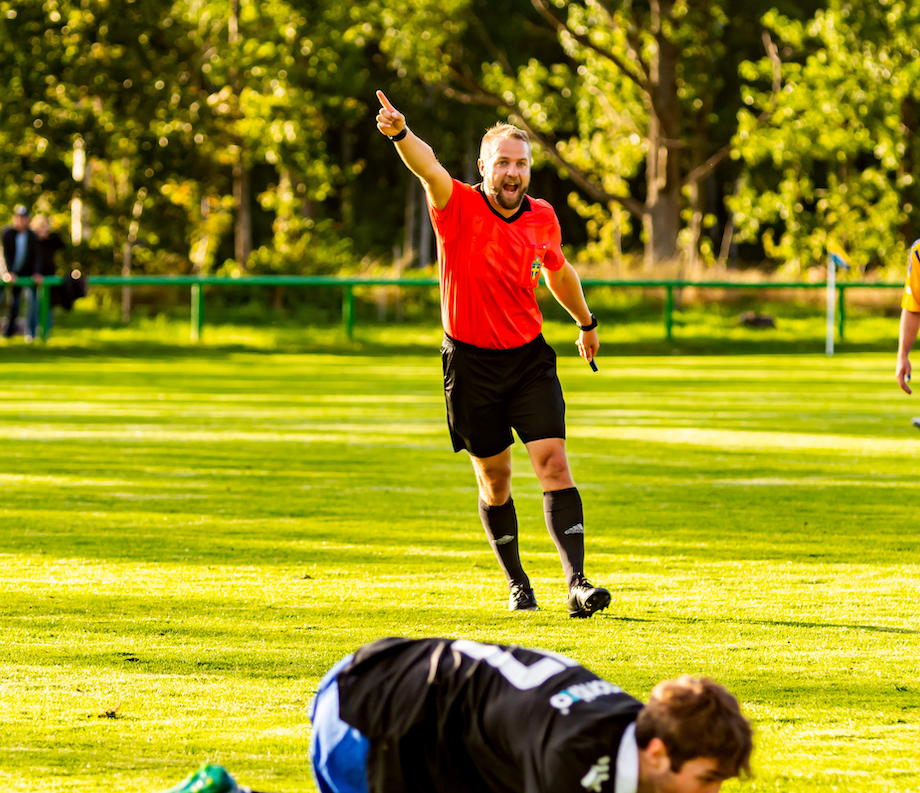
If it is a promising attack, play on and show a clear advantage with your arms and also shout of course "ADVANTAGE" or "PLAY ON", I promise you that both teams are with you and continue to play. If you are unsure here and do not show body language, the game stops, the tempo slows down and you should consider a free kick instead. Here we must also learn the technique "Wait and see". Referees are advised to give advantage only when the advantage occurs. Then you are guaranteed to give the visual signal to players and leaders only when the advantage occurs and the game can move on. Just as you can give an advantage too late, you can also give it too early. Here you need a feeling of the game, understanding of the game and gaining experience through mistakes and good advantages you give in matches. Believe me, you feel when you give a good or bad advantage, if nothing else, you will also hear it from players - who hopefully have a good understanding of the game.
Do we as referee affect the play of the advantage? Yes, of course. If we are committed, close to the situation and act early and clearly, the game will move on. Imagine if we are far away, do not read the game, are unclear and let the game go on anyway - not good. Even if the players should not act on our signals or our non-signals, they will still do so.
This is one of the tools we as referees should learn to use more often, but above all to use properly. It is clearly one of our best tools I would say. It gives the impression of a referee who is awake, involved in the game and acting clearly.
When and where should an advantage be given? The old cliché "only" on the offensive half? Most often I would say, but not always. A promising attack can be created on your own half of the field depending on how many attacking players are involved and where the defensive players are.
We end by checking out what IFAB, the International Football Association Board, says about the applying advantage. IFAB is the organization that decides on the rules of the game in football. IFAB talks about four criteria when we as referees decide whether we should stop the game or give an advantage.
- The level of the rule violation. In almost all cases where the offense gives a red card, you as the referee must immediately stop the game and give a red card. Exception: When there is a clear opportunity to score.
- Proximity to the case where the offense was committed. The closer to the target the attack is, the more effective the advantage can be.
- The chances of an immediate promising attack.
- The atmosphere in the match and match picture. The level of play that the referee has in the match and at that moment. Will a possible advantage damage the match control more than if the referee takes a free kick and slows down the match.
In addition to these four criteria, CONCACAF talks about a simplified concept, which I like, as they usually call it by the "Four P's". Ask yourself if any of the Ps are met - then give an advantage. Easily explained. CONCACAF stands for Confederation of North, Central American and Caribbean Football Association, which is the Football Association of North and Central America and the Caribbean.
- Possession of the ball. Control of the ball, meaning does the team and player who was fouled have control of the ball?
- Potential for an attack. Is there a possibility of a promising attack on the opponent's goal?
- Personnel. The skill of the attackers and how many players are attacking, is there a numerical advantage?
- Proximity. Proximity is the distance to the opponent's goal. The closer to the goal we are, the more likely it is that an advantage will be given. Here, as a referee, you can ask yourself whether the attack takes place in the attacking third of the pitch, in the middle or in the defensive third of the pitch?
I have played football most of my life, mostly as a center-back and rarely in the attacking part, but I have still managed to score a couple of goals. Like two or something . One of the most wonderful emotions in football is to score a goal, right? As a referee, the most wonderful feeling is that a goal is scored on one of your advantages. I had such a situation last year where I in my headset talked to the assistant referee when the goal was made and said: “Yes, that is our goal. We are the ones who scored that goal, do you feel the feeling, nicely done by us”. Because my AR also let the game go on.
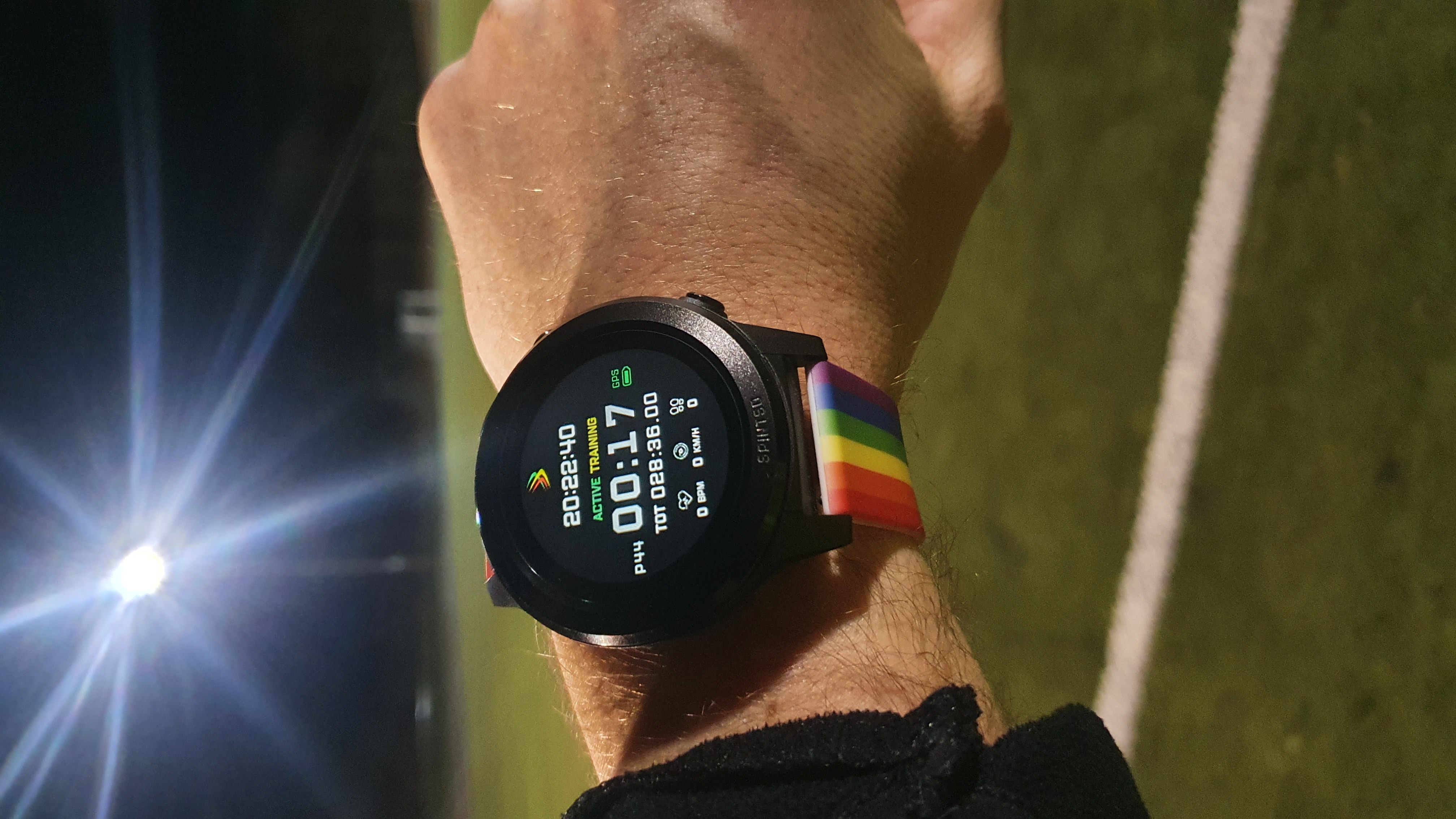
Alright, my first match for 2022 on Sunday! Yay, let’s go. On Sunday, I will definitely use Spintso's new S1 Pro. What do you think of my upgraded version with a new bracelet then?