
Interview: Andreas Ekberg FIFA referee and elite referee in Sweden 2022-02-10
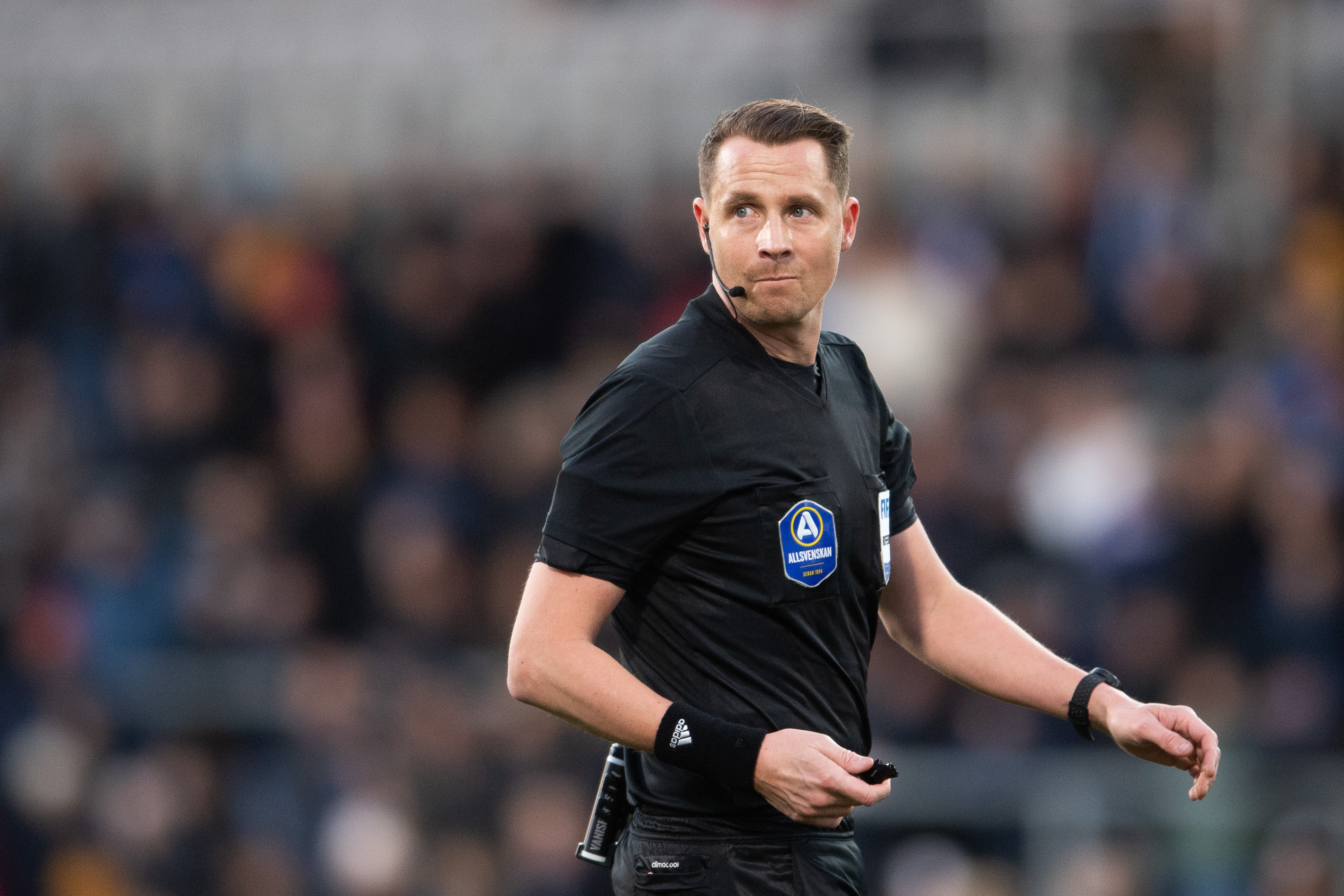
Interview with Andreas Ekberg FIFA referee from Sweden
Andreas Ekberg is one of the most experienced among the active elite referees in Sweden. Andreas has been a FIFA referee since 2013 and has officiated in up to 247 Allsvenskan matches (highest league in Sweden), an impressive resume! Andreas is particularly proud of the Liverpool-Salzburg match he officiated, which still gives him goosebumps when he thinks back on it. Read the full interview with Andreas below.
– Hello Andreas. You started officiating as a district referee in 2001, we believe. Is that correct?
– Yes, I became a district referee in 2001. Before that, I had officiated for a couple of years in my association as a club referee. At the time, it all started at a summer camp where a couple of leaders asked if anyone wanted to try officiating. So, I did it. I thought it was fun, and I officiated all age groups below mine, mostly 7-a-side, and then I later went on to take the training to become a referee in the district. I have always loved football in all its forms, and I started refereeing because I really enjoyed blowing the whistle and showing yellow and red cards, which I had only in my pocket at the beginning, haha. I thought it was fantastic fun to be a referee and didn't want to stop, but continue from there. I hadn't had the opportunity to be at San Siro, Wembley, and other major arenas as a player, but experiencing them as a referee has been wonderful. I think and hope I chose the right path there.
– What were you like as a player, towards referees?
– As a player, I wasn't nice to referees, but I always wanted to win, no matter what. I know that many elite referees, or at least some of them, tell the same stories. That they are very strong-willed and not very kind to referees. It varies, of course, but there may be something to it.
– You worked your way up from division 7 to Allsvenskan in 8-9 years. Can you tell us about that journey?
– I took almost one division per year. I didn't do many matches in division 7 but quickly moved up to division 6. Above all, I had people around me, both in my local referee club and in the district, who believed in me. At the time, the referee clubs had more control than they do today. Then I came to division four and belonged to the Skåne Football Association. In Gothia, I took a step-by-step training and was actually selected as an assistant referee for a preliminary tournament in Ystad, called the Canal+ Cup back then. Then, when I got to Gothia, I found out that I would also be officiating, and I thought that was fantastic, but we were actually assistant referees in the first place. Karl-Erik Nilsson, our current Swedish Football Association (SVFF) president, was a national instructor and responsible for my step-by-step training in Gothenburg and had us under his wing. It went so well for me there, and I got to be the main referee for games, and when I came home from there, I got a trial match in division four right away and became a regular quickly. After that, I was lucky because the league system in Sweden changed with division one and division two. When that season started and the regional leagues had been formed, I did my first match in division three and then immediately got a match in division two. Soon after that, I also got a trial match in division one, and then I officiated in division one for the rest of the season, the same season I started in division three. Then I was selected for level 5 in 2007, or maybe 2008. I got my first trial match in the Superettan league in 2007. A short history of my career, short indeed, but you could say it was a fairly fast journey.
A fast journey, indeed. Is there something you can share with other referees to help them climb up the ladder?
– I found it incredibly fun! To referee football, to lead these matches, to make the football and that match as good as possible. It drove me, and still does, forward. The competitive drive that you have as a player, I also have as a referee. To constantly move up higher and higher in the system. I was also asked at some point whether I wanted to continue playing football or focus on being a referee. I didn't have to think long about it, I put my boots on the shelf as a player and focused on being a referee. Partly because I had support from people around me who believed in me, I received very good support from the lower level. I constantly set milestones and achieved them one by one, and my dream was always to become an elite referee, the Allsvenskan league, and then my next goal was to become a FIFA referee. I have achieved many of these goals, but I still have the World Cup left as a referee. I have visions and dreams left, but it's getting harder and harder.
– What does it mean to you, Andreas, to be a referee?
– For me, it has become an identity. It touches so many people and for me personally, I wouldn't say that I am famous, but people know who I am in that world. I have lived with this for many years now, and I also know that I am a role model for younger referees. The life of a professional referee is training, preparation, conferences, analysis... to prepare for those 90 minutes. If you break it all down, those 90 minutes of football are what it's all about in the end. But for us referees, it's so much more than those 90 minutes, regardless of the level you're refereeing at. If you're at a lower level, you hopefully start planning and preparing for the match days before, travel to the match, talk after the match, and so on. This applies to all referees, but of course, it's even more true for us elite referees.
– Okay, let's change the subject for a while. As referees, we usually know the rules and regulations pretty well. But those who watch football may not know them as well. Is there something we referees can do to increase knowledge or understanding of the role of referees?
– A few years ago here in Sweden, we attempted to participate in more interviews after matches and so on. Unfortunately, we were usually only asked to participate when something negative happened to us, like missed penalties, missed red cards, or chaos in the match... or whatever it was. Everyone already saw that it might have been a clear penalty that Ekberg missed. Then we, the referees, would go out in the media and say "yes, I apologize for the missed penalty." This had the opposite effect in the media, as the referees would just go out and say that it was wrong, and then leave. However, when it comes to situations that are tricky, that don't necessarily need to be right or wrong, but to increase public understanding. For example, offside, in the recent World Cup there were some situations that I barely understood, not even with 7 replays. That says something about how difficult it is to be a referee. I think we can do better at reaching out with such things. I have a practical example from the cup final between Hammarby and Malmö, last year. It is the year's most obvious penalty for Hammarby, where a player is pulled down in the penalty area. It's super obvious. The thing about that situation is that the ball is not in play. It becomes in play a second later and nothing comes of it. Then experts, commentators, media and everyone watching ask "how could he miss that?" After that, I received threats on my phone and there was a lot written in the media. In that situation, one might think that we would go out and say that it cannot be a penalty according to the rules. That's where I think we can improve, all of us who are referees and the people around us too. To explain these decisions. UEFA has a policy that we are not allowed to talk in the media around matches, but maybe someone else around us should explain? Discovery is doing a fantastic thing here in Sweden now, where they follow us referees before, during, and after the match. You get to see things from our perspective. I think that's the right way to go to get more people to understand how we work.
– You have officiated 247 matches in the Allsvenskan and over 100 international matches, and you are one of the most experienced referees in Sweden as an elite referee. Despite your experience, are there things that you focus on extra?
– Not specific things like handball or offside perhaps. For me, it is very much about leading the matches in a good way. That is number one, at all levels, but especially for us at the elite level. To lead a match in a good way and then to make the big decisions such as penalties and red cards, for example. Everyone who watches wants to see a good football match and if we as referees can contribute to that, it's good. Then we always analyze the teams and matches, quite extensive ones. I can give an international example, if I have a Champions League match, I receive a PDF file from UEFA's analysts that can be about 50 pages per team. It includes everything from their strategies, playing styles, set pieces, crosses, zone play, and so on. Sometimes it's a bit too much information to take in, but you can definitely pick out the most important things and then think about it before and during the match, again to lead the match in as good a way as possible.
– This interview is with you, and about you Andreas. But you are also part of a team of referees. What does your referee team mean to you?
– They mean everything! I would say everything. I've had the same team for quite a few years, but one of my assistant referees, Stefan Hallberg, retired last year, and now I have Nicklas Nyberg and Mohammed Culum. At the level we're at, we have to work together, trust each other, and work together off the field when we're away at matches or tournaments. There's a lot that has to work for these 90 minutes to be as good as possible. The classic, we win as a team and lose as a team, is really true. Without them, I wouldn't be where I am, and without me, they wouldn't be where they are. It's really teamwork, no doubt about it. We also have another aspect internationally with VAR, where we have another dimension to teamwork and more colleagues where we have to make big decisions. We don't have it yet in Sweden, but I think it should come here, we'll see.
– You've touched on this already, but what are your goals for the future?
– Now it's about maintaining where we are, primarily. To be able to stay in the game as long as possible, the eye of the needle is getting narrower and narrower. One negative thing for Swedish referees internationally is that we don't have VAR here in Sweden. Other countries have it almost every day and week. It's a huge switch for us to referee with it and then come home and referee without it. We have new goals and matches all the time, and we take one match at a time, that's how it works.
– Is there any match you can look back on and be a little extra proud of?
– Yes, I refereed Liverpool against Salzburg in the first round of the Champions League group stage. Liverpool had won the Champions League the previous year and were still celebrating that victory. The stadium was full at Anfield and the match ended with a score of 4-3 to Liverpool. Haaland came on for Salzburg and scored a goal when he played there. That match was an amazing experience and is a match that I will always remember a little extra.
– Thank you for this, Andreas, and good luck to you and your team.